The 1-3-5 Rule: The Architecture of a Realistic Day
How to Eliminate the Tyranny of Endless Lists, Cap Daily Cognitive Bandwidth, and Anchor Genuine Priorities Before Others Dictate Your Agenda
The most prevalent driver of chronic executive exhaustion and perceived inadequacy is the endless daily to-do list (The Endless To-Do List).
Every morning, corporate offices divide into two major archetypes of professionals trapped within the identical systemic flaw:
- The Trap of To-Do List Debt:
Under the direct influence of the Planning Fallacy, an ambitious leader drafts a sprawling catalog of 20 to 25 massive objectives. By midday, two operational brushfires and an overextended meeting collide with the schedule. By 6:30 PM, the individual has checked off only a handful of items, while the remainder carry over untouched. They depart for the evening depleted of energy, yet weighed down by guilt: they worked non-stop, but feel as though they failed. - Completion Bias (The Seduction of False Productivity):
At the opposite extreme lies an innate behavioral tendency documented in 2016 by researchers Francesca Gino (Harvard) and Bradley Staats (UNC): the human brain subconsciously gravitates toward brief, low-friction micro-tasks simply to secure the rapid dopamine hit associated with checking a box. The manager packs their day with 40 procedural trivialities, signs routine sign-offs, and forwards attachments. By evening, they enjoy the illusion of a highly productive day, while the enterprise has stagnated: every decision demanding rigorous analytical discernment was postponed.
Both pathologies stem from the identical architectural absence: the refusal to establish a mechanical boundary over daily operational capacity.
The 1-3-5 Rule intervenes precisely at this fault line: an unyielding calibration protocol designed to align professional ambition with the finite biological envelope of a single working day.
What Is a “Task” and the Trojan Horse of the Inbox
The fastest route to sabotaging the 1-3-5 framework is deploying an ambiguous definition of what constitutes a task.
Listing “Responding to emails” as a single minor item on your morning agenda smuggles an operational cluster bomb directly into your calendar:
- Inbound communication channels (email, instant messaging, ticket queues) are not tasks in themselves; they represent an unbounded pipeline through which the priorities, anxieties, and demands of external parties flood your desk;
- Upon opening the inbox, dozens of unread messages await: some require routine confirmations, but others conceal complex contractual disputes or multi-variable analytical requests;
- If you attempt to resolve issues chronologically as you read them, what appeared to be a 15-minute administrative task instantly detonates into four medium tasks and one massive crisis, vaporizing the remainder of your morning.
A task is neither a communication conduit nor a vague intention. A task is a bounded unit of work with clear parameters, a strict timebox, and a quantifiable Definition of Done (DoD):
- “Triaging the email inbox for strictly 30 minutes (confined entirely to archiving, delegating, and deleting, without opening execution files on major initiatives)” is one medium task;
- Complex dilemmas unearthed during triage are not resolved in-stride. They are systematically extracted and routed through the priority engine: they become tomorrow’s Big Task, are transferred to the Personal Parking Lot, or are delegated via standard handover protocols.
The Forest of Trivialities: Why We Flee Strategic Decisions
Why is it so instinctively tempting to retreat into dozens of administrative details rather than confront a heavy strategic bottleneck?
The answer resides in the psychology of cognitive friction:
- High-stakes decisions—restructuring an executive commission architecture, negotiating a fractured partnership, or re-engineering a failing operational pipeline—demand intense focus and the psychological discomfort of navigating ambiguity. There is a tangible risk of error, and accountability is visible;
- Conversely, routine tasks provide an emotionally comfortable sanctuary: they require linear, mechanical execution, carry zero reputational risk, and supply a perfect moral alibi: “I cannot address the strategy right now; I am buried beneath urgent administrative demands.”
This “flight into the forest of trivialities” is frequently an intersection of natural anxiety before high-stakes complexity and a defensive perfectionism that polishes minor details to delay facing the primary obstacle.
The 1-3-5 Rule systematically eliminates this refuge through an unyielding structural constraint: it compels the executive to anchor the day around a core strategic deliverable before routine is permitted to claim bandwidth.
The Anatomy of the Three Tiers: The 9-Commitment Envelope
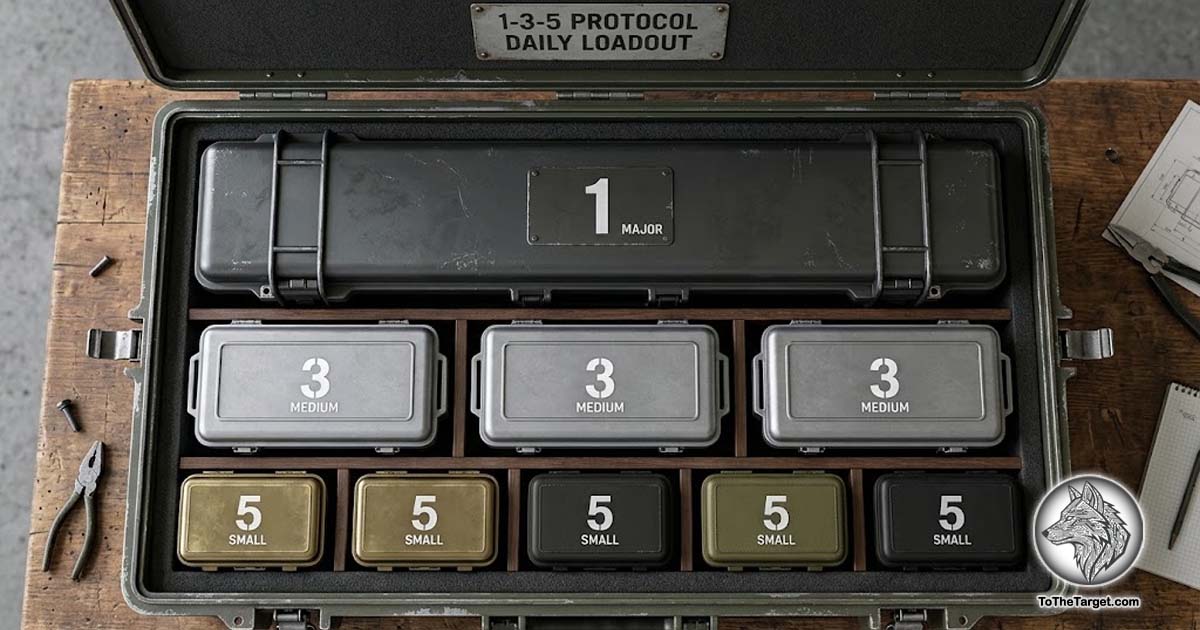
Daily cognitive and operational capacity is capped at strictly nine commitments, tiered across three levels of impact:
1. The BIG Task (1 — The Anchor / The Systemic Decision Test)
The definitive deliverable of the day. If this were the single item completed before departure, the working day represents an indisputable operational victory:
- Filtering Criterion: The Output vs. Input Test. The Big Task is invariably an act of creation or systemic decision (authoring an operational procedure, finalizing a critical contract, engineering an annual capital allocation, resolving an architectural bottleneck). It is never passive information consumption;
- Calibrated by Role Altitude: For a technical specialist, the Big Task represents an uninterrupted 90-to-120-minute Deep Work sprint. For a C-level executive or founder, the Big Task is frequently a high-stakes, high-trust strategic interaction—a decisive alignment with a major partner, a critical negotiation, or bringing fractured department heads into consensus—a process demanding absolute presence, psychological acuity, and mature discernment;
- The Iron Rule: Strictly one per day. Scheduling two big tasks divides prefrontal bandwidth and guarantees neither achieves excellence.
2. The 3 MEDIUM Tasks (3 — The Traction Engines / The Domino Test)
Critical operational deliverables, each requiring between 30 and 60 minutes of focused effort:
- Filtering Criterion: The Domino Test. A viable medium task deblocks downstream workflows: “Does completing this item make three other tasks this week significantly easier or entirely unnecessary?”;
- Operational Examples: Running an operational alignment session governed by a rigid agenda (45 minutes); auditing a quarterly cost variance ledger; signing off on a major procurement dossier;
- The Iron Rule: Maximum three. They represent the sustained operational momentum of the day, executed after the primary Anchor is secured.
3. The 5 SMALL Tasks (5 — Routine Maintenance / The Processing Test)
Administrative support, rapid communication, and procedural items requiring 5 to 15 minutes each:
- Filtering Criterion: The Status-Quo Maintenance Test. Approving standardized leave requests, signing banking documents, an agile coordination call, dispatching routine confirmations;
- The Iron Rule: Executed during lower-energy periods or within buffer windows between medium tasks. Commencing the morning with small tasks is procedurally prohibited.
Daily Ergonomics: Pacing, Interleaving, and the Shutdown Ritual
To ensure sustainability, daily execution must conform to natural biological pacing:
- The Morning Strike on the Big Task:
Task 1 is scheduled in the opening stable working window of the morning, when prefrontal glucose and dopamine reserves are at their daily zenith. Securing this deliverable before 11:00 AM permanently defuses the psychological pressure of the day. - Interleaving as Active Decompression:
Chaining three medium tasks back-to-back in an analytical vacuum induces cognitive fatigue. Deploy one or two small tasks (a 5-minute call, signing an operational sign-off) as active decompression buffers between medium-intensity sprints. - The Rigid Envelope and the “One In, One Out” Rule:
If an unexpected high-priority request emerges mid-day, the capacity container of nine items does not expand. A zero-sum trade is mandatory: to onboard the new item, an existing task is systematically evacuated:- Reallocated to the Personal Parking Lot with a definitive execution slot later in the week;
- Delegated via an explicit handover protocol;
- Or declassified into Won’t Have without emotional guilt.
- The Evening Planning Ritual:
The nine commitments are established before departing the office the preceding afternoon. Arriving at your desk in the morning asking what to do burns noble energy purely on orientation: if you do not maintain a definitive plan for your day, external parties will ensure they dictate your agenda. - Conscious Shutdown Upon Completion:
When the nine commitments are fulfilled, stop. Do not hunt for artificial busywork to fill remaining time. Respect the day’s victory, disconnect, and conserve cognitive reserves for tomorrow.
Managing Calendar Monoliths: Board Reviews and Fixed Milestones
In executive governance, certain calendar days are dominated by macro-events: a 3-hour quarterly board meeting, an institutional audit, or a designated full-day internal review.
Attempting to enforce the standard 1-3-5 blueprint on these days is a failure of planning:
- The macro-event is the Big Task of the day (1): a board session or major audit exhausts tremendous prefrontal energy;
- The envelope compresses automatically: on these dates, the agenda shifts to 0 additional Big tasks, 2 Medium tasks, and a maximum of 3 Small tasks;
- The framework adapts to empirical calendar reality, sustaining control without generating artificial pressure.
Executive Conclusions
- The Reactive Task-Junkie: Launches the day without an anchored plan, permits the inbox to dictate direction, retreats into ticking micro-tasks out of a reluctance to confront complex decisions, and accumulates an unmanageable debt of uncompleted work.
- The Sovereign 1-3-5 Architect: Understands the biological boundaries of daily cognitive capacity. Secures the primary strategic battle before noon, leverages medium tasks as dominos to deblock the organization, compresses routine maintenance, and maintains operational sovereignty by refusing to oversubscribe the calendar.
A mature leader does not measure the success of a day by the volume of hours clocked at the desk, but by the strategic weight of the deliverable completed before lunch.
Select one big task, three medium tasks, five small tasks—and command the day with rigor!
If you liked this article, you’ll love what’s inside. This tool is forged and battle-tested inside our playbooks: