This is a favorite topic among motorcyclists. It sounds complicated, sophisticated—a technique only “the pros” master. I’ve heard instructors speak with disdain about riders with thousands of miles who have no idea what the term means.
The truth? If you’ve ever taken a corner at more than 20 mph and didn’t end up in a ditch, you’re already countersteering. Your body instinctively learned to trick physics to keep you on two wheels.
The official term is Countersteering, but you can call it Counter-deflection if you want to sound like a fighter pilot elite. It simply means this: to turn right, you push the handlebar to the left; to turn left, you push to the right. It’s the exact opposite of what you’d expect and the opposite of how a car works. That’s why it seems so complex—because it’s counterintuitive.
Why learn something you already do?
Bringing this instinct into the light is vital for two reasons:
- Emergency Control: In a panic, instinct might save you, but knowledge makes you a master. When a car cuts you off, you need to know consciously that a quick push on the right grip will instantly flick the bike to the right, saving your life.
- Balance is an Illusion: A motorcycle is never perfectly upright; it’s in a constant “dance.” Once you understand this, you stop fighting the bars and start conducting them.
The Magic of the Truncated Cone
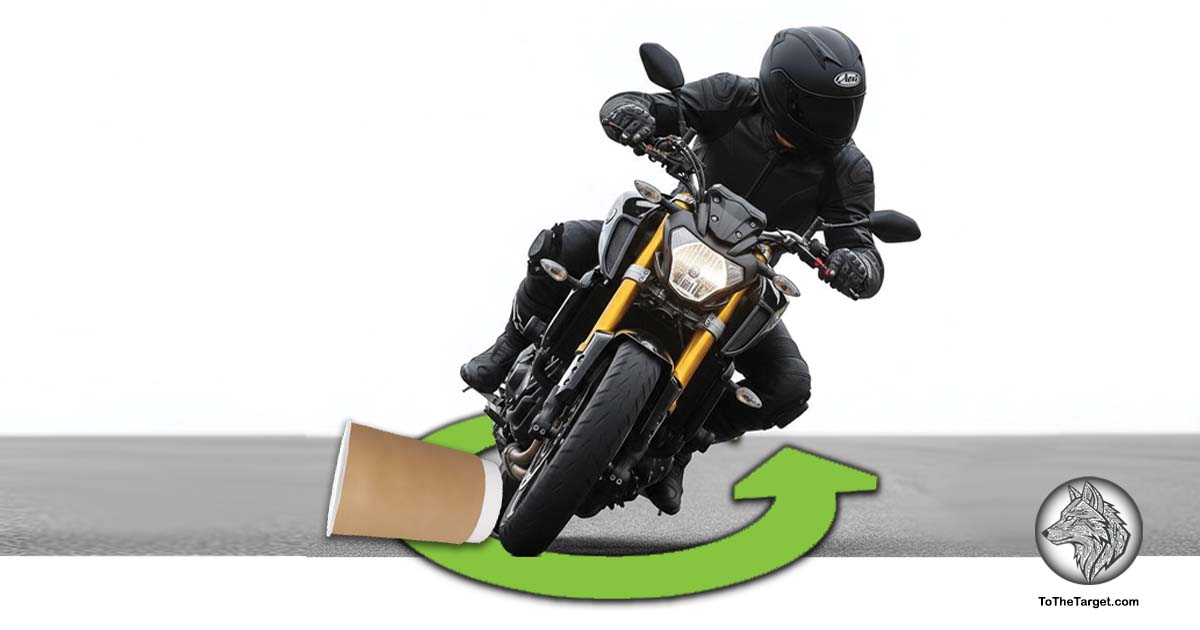
Imagine a paper cup laid on its side on a table and pushed—it won’t go straight; it will roll in a circle. A motorcycle tire has a rounded profile. If we looked only at the bottom where it touches the ground, it would look like two paper cups glued together at the rim. If we convince the bike to lean, it will follow that “cup trajectory” and turn.
But how do we get it to lean? Because the bike wants to go straight. We already covered this in the article on gyroscopic force. This is where the technique comes in: when you push the handlebar, you aren’t steering; you are unbalancing the bike. It leans obediently and begins to turn.
No, you won’t fall. Remember what I told you? The bike wants to rebalance itself. That’s the whole secret: you push, it unbalances, it leans, it turns, and when you relax the pressure, it begins to rebalance. In practice, you’ll perform this fine play of adjustments on every corner, depending on the effect you want.
Not so hard, was it? I advise you to head to an empty parking lot, play with the bars a bit, and feel the movement. Don’t force it; use just two fingers. You’ll see how easy it is. With a bit of practice, you’ll move from being a lucky passenger to a conscious pilot.
If you liked this article, you’ll love what’s inside.
A book packed with useful advice, written in a “no-fluff” style, like a conversation between friends.