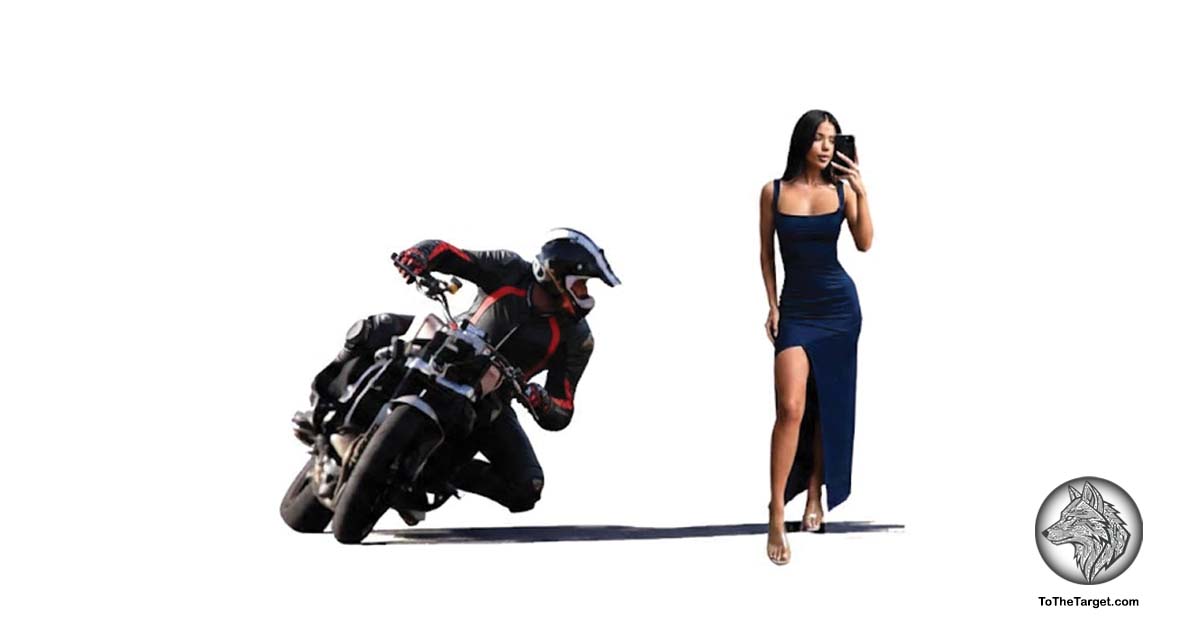
You’ve probably seen those viral clips of beginner riders who “manage” to crash into the only parked car on a wide-open street, or who inexplicably leave the road only to hit the one tree in the middle of a field.
You ask yourself: “How did he manage that? How can someone be that stupid? He had all the space in the world.”
The truth is, it’s not stupidity, and it’s not magic. If you were put in a similar situation without knowing what’s happening, you’d do the same. And no, there are no invisible magnets pulling you toward the danger you’re trying to avoid. There’s nothing paranormal about it; the explanation lies in how your survival system is wired. When you look in a direction, your entire biological assembly unconsciously prepares for that trajectory.
The Trap: Obstacle Fixation
“Fixation” is the inability to shift your attention away from a powerful stimulus. In our case, we’re talking about the moment you lock onto an object—a car cutting you off, an animal darting across the road, a tree, or a simple pothole—and you just can’t tear your eyes away.
Can you guess what happens next? Ironically, if you fixate on an obstacle out of fear of hitting it, there’s a massive chance you’ll head straight for it.
Your Biological Autopilot Imagine you’re on a sort of autopilot. You set the coordinates (where you want to go), and this complex system analyzes the visual input and finely adjusts your reflexes, the tension in your forearms, and your body lean to maintain that path.
Your “autopilot” receives the coordinates of the target and reacts just like a missile guidance system: it will correct the trajectory so that you hit the target dead center.
This phenomenon usually occurs during a panic spike, when you don’t know what to do. Your entire nervous system freezes, locked onto the last instruction received under the influence of adrenaline: “Go to target!” Your heart pumps wildly, your muscles lock up, and you become a mere passenger on your own motorcycle, heading fatally toward danger. It’s as if your brain, under stress, enters “self-destruct” mode.
How to Use Target Fixation to Your Advantage
- Find the “ The Way Out”: Suppose an unexpected obstacle appears. The golden rule: Stop looking at it. Your brain already registered it in the first fraction of a second, your heart felt the danger, and the basic calculations are done. Now, your system needs new instructions—an exit strategy. Instead of freezing your gaze on the danger, force your eyes to hunt for the solution: the point where you want to arrive to bypass the obstacle. The moment your eyes find the clear path, the rest of your body will naturally follow that rescue command. Train your gaze to hunt for solutions, not problems.
- In Corners: This is where following an imaginary trajectory is hardest because the reference points change rapidly. If you look straight ahead, you’ll go straight—right into the scenery. But your path is curved. You must follow the road’s design, not the static horizon. Look for the exit point of the turn and fixate your gaze there. Even if the exit isn’t physically visible yet, turn your head and keep looking for it; it will appear shortly, and your “intelligence network” will make all the necessary lean adjustments to keep you on track. It’s like having a magnet in your eyes pulling you through the curve.
Final Tip
If you want to admire the view, the buildings, or the beautiful girls on the side of the road, your best bet is to pull over. When you’re in motion, always look where you want to be in two seconds. On a bike, where you look is where you write your destiny. Those who lose their gaze in the scenery instead of the road have every chance of tragically becoming part of the scenery themselves. Riding demands your total possession; the rest of the world can wait until the next stop.
If you liked this article, you’ll love what’s inside.
A book packed with useful advice, written in a “no-fluff” style, like a conversation between friends.