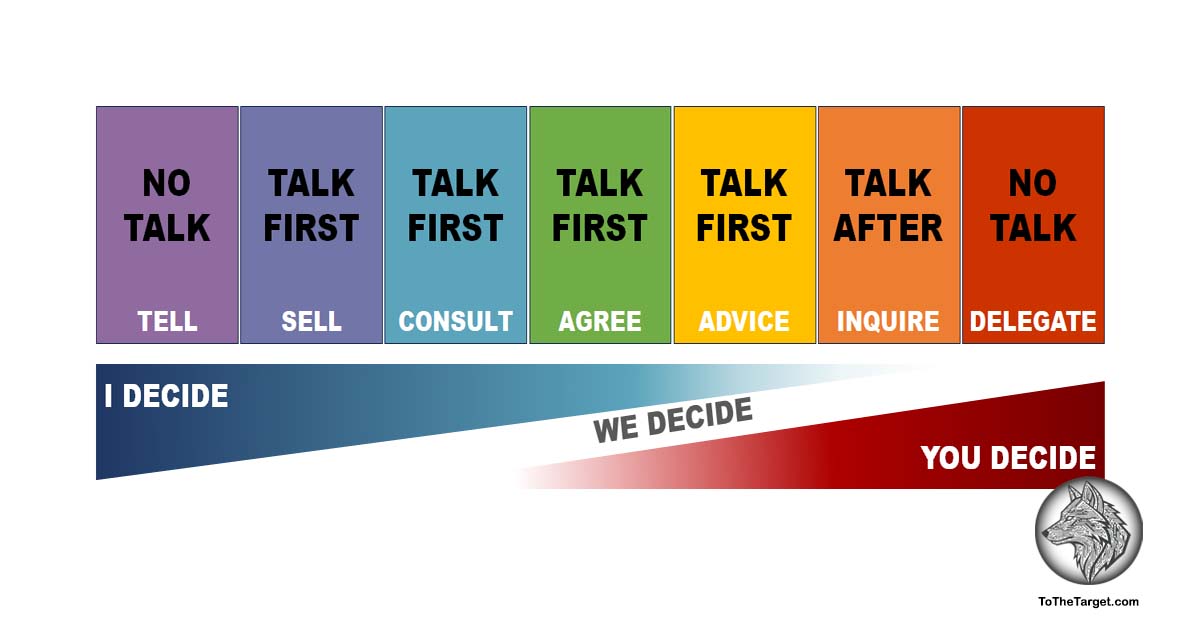
“I delegated the task, but it ended up back on my desk” or “They ask me for permission even to breathe.” If you find yourself in such situations, the problem isn’t necessarily your employee—it’s that your delegation wasn’t properly “tuned.” You’ve likely used a binary approach: either you do everything yourself, or you let go completely and hope they don’t hit a wall.
In reality, delegation is a spectrum, a 7-step potentiometer. If you don’t establish from the start which “number” your employee’s authority is set to for a specific task, you are condemned to micro-management or, worse, to fires that only you can extinguish.
Here are the 7 levels of authority you should use, depending on the context and the person you are delegating to:
- Level 1: TELL. There is no democracy here. I decide, you execute. This is the minimum level of delegation, useful in extreme crisis situations where there is zero time for debate, or when working with a “Passenger” who needs instructions like “press this button at 10 AM.”
- Level 2: SELL. I decide, but I explain why. This is an excellent tool for the “Enthusiastic Junior.” You don’t just give the order; you “sell” the logic behind it. The goal is to build their context so that, in the future, they can climb to higher levels.
- Level 3: CONSULT. I decide, but only after listening to you. This is where you start using the team’s brain. You ask: “What would you do?”, listen to the arguments, but the final decision remains yours. This is the step where you check if your person is starting to think strategically.
- Level 4: AGREE. We decide together. You are equal partners in this decision. This is a democratic level, but beware: it is also the most dangerous. Without a tie-breaking system, you can reach a stalemate. Use it rarely, only on projects where consensus is vital.
- Level 5: ADVISE. You decide, but you consult with me. Here, control shifts to the employee. They have the decision-making power, but they are obligated to come to you for a “sanity check” before signing off. This is the ideal safety net for those transitioning to “Star” status.
- Level 6: INQUIRE. You decide on your own, but you inform me immediately. The “Star” level. You no longer need prior consultations. You trust your person’s judgment; your only condition is to be informed post-factum. “I decided X, I did Y, everything is under control.”
- Level 7: DELEGATE. You decide; no need to tell me. This is the “Holy Grail” of management. Total trust on a recurring task. You know the standard of performance (DoD) will be met without you ever hearing about the subject again.
Conclusions
- The fatal mistake is treating everyone at Level 1 or throwing them straight into Level 7. A good manager is an “authority coach.” How do you practically set the delegation level for each subordinate? I would advise using the Skill & Will Matrix, but slightly modified. You don’t delegate just because someone “wants” to (Will). You delegate because they have the technical competence (Skill) and because you have the Trust that they will make the right decision in your absence.
- Communication is always vital—you must eliminate ambiguity from the start by “Naming the Level.” Unspecified delegation is a ticking time bomb. If you think you’ve delegated at Level 7 (Autonomy), but they think they received the task at Level 2 (Selling), you’ll be frustrated that they aren’t acting. If it’s the other way around, they’ll make decisions that will leave you stunned. The solution: explicitly state the number. “For this project, you are at Level 5.”
- The Final Goal: To move as many people as possible toward Levels 6 and 7. It’s the only way to scale a business without becoming the bottleneck of your own company. Only when most of your team is at Levels 6 and 7 can you say you have a high-performance Execution Engine that works without you. Until then, you’re just an exhausted dispatcher trying to control traffic.
Theoretical Context
In theory, this concept is known as The Ladder of Authority or Levels of Delegation.
- The 5-Level Version: The Tannenbaum-Schmidt Model. Created in the 1950s, this is the classic “Leadership Continuum.” The steps are usually: Tell, Sell, Consult, Join (Agree), and Delegate.
- The 7-Level Version: “Delegation Poker.” Popularized by Jurgen Appelo within the Management 3.0 system. We chose it because it covers the nuances between “I decide” and “you decide,” introducing the grey areas of consultation and agreement (Levels 3, 4, 5). It is more granular and better suited for modern, complex teams.
If you liked this article, you’ll love what’s inside. This tool is forged and battle-tested inside our playbooks: