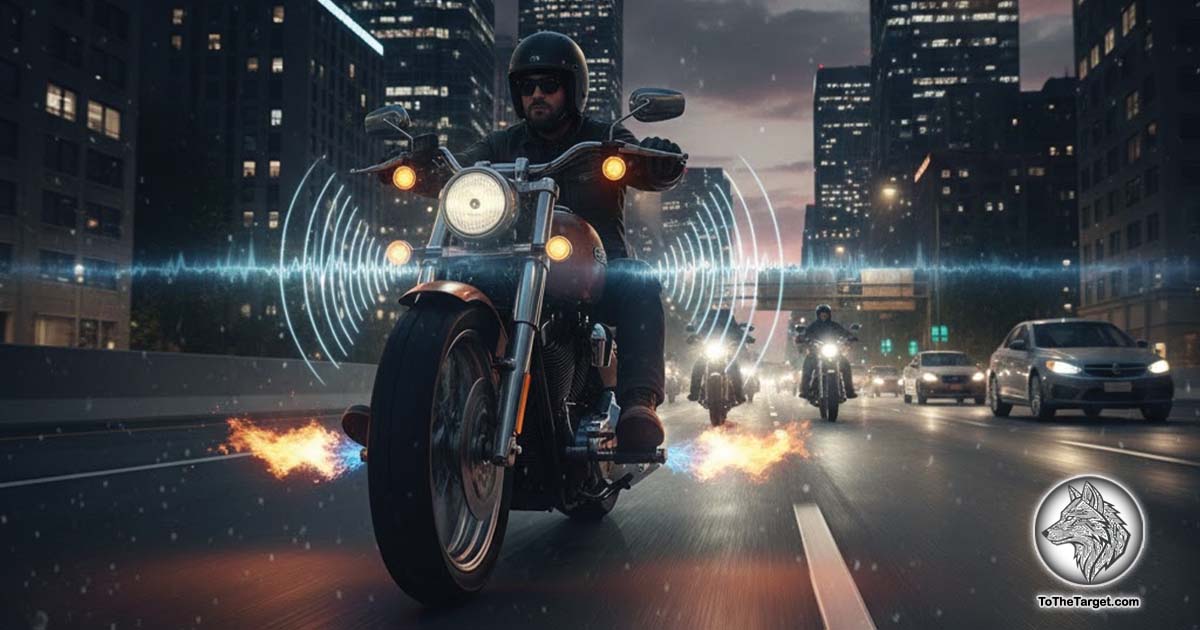
Loud Pipes Save Lives
“This is one of the most widespread and, let’s be honest, most hypocritical stereotypes in the motorcycle world.
Sure, in theory, noise might attract attention, and there is a tiny chance it could help you avoid an accident. But let’s be real: loud pipes are the very last safety measure a sane person should ever rely on.”
It’s fascinating to hear this “safety” line from a “tough chopper guy” wearing nothing but a leather vest and a novelty helmet, or from a “racer” flying by in flip-flops and shorts.
It’s exactly like the OnlyFans excuse: everyone claims they’re only there to ‘support independent creators,’ when in reality, we all know exactly what kind of ‘content’ they’re paying for.
If you’re riding in flip-flops but have pipes that wake the dead “just to stay safe,” you’re lying to yourself. You don’t care about safety; you care about being seen. The noise is just your “cultured” excuse for a primal need for attention.
Those who shout that “loud pipes save lives” are actually proponents of passive safety. They operate on the premise that an accident is inevitable and their only chance is for the “idiot” in the car to hear and avoid them. It’s a victim’s mindset. The question “Why didn’t you see him first?” never even crosses their minds.
Actually, we can’t even call it passive safety—because if that were the case, they’d be wearing gear. It’s more like “passive hope.”
On the other hand, the active rider knows that his life depends on his own eyes and brakes, not on the ears of others. The noise argument crumbles at the first logical analysis: if you really want to attract attention in a critical moment, why don’t you use your horn? It’s mounted on the handlebar, just a thumb-click away, specifically for that purpose. But you don’t use it, because, in reality, safety isn’t your goal—the spectacle is.
The 4 Illusions of “Life-Saving Noise”
Let’s assume, for the sake of argument, that noise actually is a safety measure. For it to work, the planets would have to align in an almost impossible way. Specifically, you are betting your life on four illusions:
- That the driver is paying attention to outside sounds. (Spoiler: he isn’t. He has the music cranked up, is talking on the phone, or is preoccupied with his bills). Besides, modern cars are exceptionally well-insulated; exterior noise is filtered out.
- That he can pinpoint exactly where you’re coming from. (Try locating an ambulance by sound alone without seeing it. Hard, right? Sound bounces off buildings and asphalt).
- That sound travels forward. (Most exhaust pipes face backward. By the time the person in front hears you, you’re already at their door or under their wheels).
- That the driver even cares. (A jerk might actually feel provoked by your noise and decide to “close the gap” on you).
The Need for Attention and the “Safety” Excuse.
If loud pipes were truly about safety, we would see riders in high-visibility vests and top-tier gear, but with silent exhausts. The reality is exactly the opposite: the loudest riders are, more often than not, the ones with the worst gear.
The truth is simple: many get a motorcycle just to be noticed. They want to turn heads and use “Loud pipes save lives” as a moral shield. It’s much easier to swap an exhaust than to learn how to brake or to wear a yellow vest—which might make you look like a road worker, but would actually make you visible.
If you want aesthetics, there are civilized solutions: adjustable exhaust systems. You can be “loud” at the parade with the boys and “silent” when you pull into your neighborhood at night. It’s a matter of common sense, not technology.
The “Invisible” Bonus: Fatigue. And there’s something else many overlook: that “cool” noise becomes a nightmare after the first 100 kilometers. The constant vibration and the thumping in your helmet do nothing but fry your nervous system. An excessively loud exhaust wears you down mentally much faster than the wind or physical effort ever could. And what happens when you’re tired? Your reaction time increases, and your focus drops.
In your desperate attempt to stay “safe” through noise, you are essentially destroying the only real weapon you have: your brain. You become a worse rider simply because you wanted to sound louder.
Of course, this only applies if you actually ride. For the ‘cafe racers’ who only travel two miles to the nearest terrace and back, fatigue isn’t the issue—finding a spot where everyone can see their bike is.
The “Silent Gray Fellow” and the Bill We All Have to Pay
Over 100 years ago, Harley-Davidson released the “Silent Gray Fellow.” It was their pride and joy—a machine they managed to make remarkably quiet. It’s a bitter irony that today, that very brand is associated with the deafening roar that wakes up entire neighborhoods at 2 a.m.
But look at what Harley-Davidson’s own president, Jim McCaslin, said back in 2005: “We should think about the consequences of our actions on others before others take action against us.”
And “the others” are already acting. In many cities across Europe and around the world, motorcycles are being banned from certain areas or during specific hours due to noise pollution. When you choose to be a “tough guy” and shatter people’s eardrums under the pretext of your imaginary safety, you are doing nothing but endangering the freedom of movement for the entire riding community.
The conclusion is brief: If you need noise to feel safe, it means you aren’t a rider—you’re just a victim hoping to be heard. A real motorcyclist is silent and decisive; they avoid, they brake, and they survive through skill, not through sonic pollution.

If you liked this article, you’ll love what’s inside.
A book packed with useful advice, written in a “no-fluff” style, like a conversation between friends.