The Great Purge of Digital Meetings
How to Eliminate the Theater of Turned-Off Cameras, Enforce the “Single Pizza” Rule, and Transform Remote Collaboration into an Engine of Sovereign Performance
Remote work represents one of humanity’s greatest civilizational breakthroughs:
- It recovers two hours of personal life every single day, otherwise incinerated in gridlock traffic and overcrowded subways.
- It collapses physical distance—allowing an operator to teleport instantaneously into an office in London or Los Angeles.
- It directly elevates quality of life: freed from the necessity of an overpriced, cramped apartment near city centers, professionals can fulfill the dream of building a quiet, affordable home close to nature.
PART I: THE ANATOMY OF THE PATHOLOGY (From Miracle to Digital Chaos)
Insecure, untrained management transformed this newfound autonomy into a digital panopticon of back-to-back, unceasing meetings. Ask any employee inside a modern enterprise to describe a typical working day, and they will outline an absurd corporate comedy:
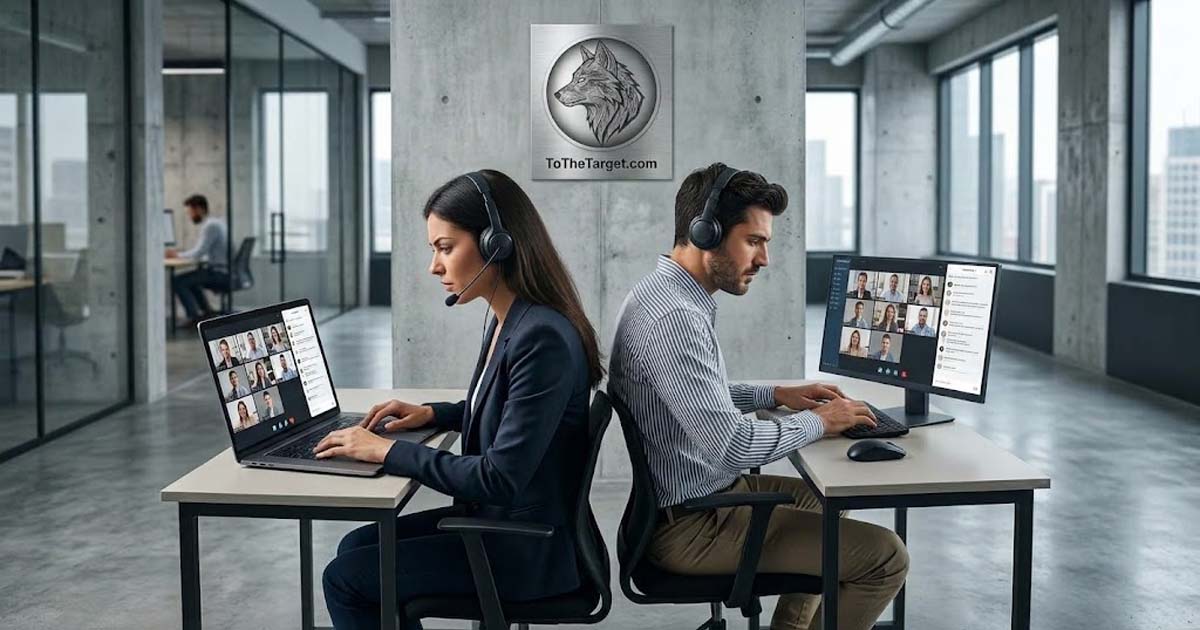
Colleagues who endured a brutal morning commute sit two meters apart in an open-plan office, headsets clamped over their ears, shouting into microphones on Microsoft Teams. Participating in that exact same call are ten remote colleagues: a gallery of black circles displaying static initials, muted by default.
A single director shares their screen, reading aloud for 45 uninterrupted minutes from an exhaustive, text-heavy slide deck. And the remote attendees? One is frying eggs in the kitchen, another processes secondary emails, another shops online, while the remainder gaze blankly out the window. The cumulative contribution of 90% of the room amounts to a mumbled “Good morning” upon entry and a robotic “Thanks, have a good one” upon adjournment. Predictably, the single operational detail that actually demanded their attention was debated during the exact two minutes they stepped away to the restroom.
Compounding this misery is the elimination of biological transit buffers, the primary catalyst of modern Zoom Fatigue: clicking Leave at 10:59:59 and clicking Join at 11:00:00. Professionals sit frozen in their chairs for six consecutive hours, staring unblinkingly into blue-light monitors.
This is not modern collaboration; it is an industrial squandering of executive payroll and human cognitive bandwidth. To protect the freedom of remote work and eradicate this performative theater, leadership must deploy the Digital Guillotine.
The Cowardice of the Frictionless Digital Medium
Boxing legend Mike Tyson delivered a memorable observation regarding the internet: „Social media made y’all way too comfortable with disrespecting people and not getting punched in the face for it.”
The exact same pathology infected the corporate ecosystem: zero technological friction annihilated operational accountability. Today, any employee can click a button and fire off a calendar invite to 20 colleagues, without expending effort, bearing zero friction, and feeling zero shame.
In a physical office building, convening a useless meeting carried an immediate social and visual cost. To assemble 15 people, an organizer had to physically reserve a conference room, look peers in the eye, and risk an exasperated colleague slamming their notebook on the table for wasting their afternoon. Furthermore, the disruption was visible: ten professionals closed their laptops, stood up from their desks, traversed the hallways, and vanished behind closed doors for two hours. The entire organization observed the exodus and asked what decision they were manufacturing to justify that burn rate. A healthy pressure of public accountability governed the floor.
On Teams or Zoom, this disruption became completely invisible. The employee never rises from their chair. They remain rooted in front of the identical monitor. Because there are no footsteps echoing down the hall, the manager entertains the comfortable delusion that they interrupted no one, when in unvarnished reality they shattered the deep focus of ten colleagues with a single click.
Even the most invasive manager in a physical workplace possessed a natural biological governor. When summoning a subordinate—”Step into my office for five minutes!”—the executive experienced the physical passage of transit time. Five to seven minutes elapsed while the subordinate saved their files, walked down the stairs, and knocked on the door. During those brief minutes, common sense frequently intervened: it made no sense to pull an operator across the building for a binary “Yes” or “No” answer. Physical distance operated as a natural friction filter against administrative impulsivity.
Inside the digital operating environment, that friction was eliminated. Effort is zero: click a link and launch an instant video call. And from that lack of effort cascades the toxic avalanche reflex: “While we have this window open, let’s pull Mark into the call… Oh, wait, Sarah should probably be here too…”. In under two minutes, an elementary one-sentence inquiry is mutated into an ad-hoc video summit of five people that incinerates 40 minutes of working memory across the board.
The Two-Headed Hydra: How Real-Time Chat Fuels Meeting Bloat
You cannot cure video meeting bloat if you permit internal chat channels (Slack, Teams) to operate as an unregulated jungle. Jason Fried, founder of Basecamp, diagnosed this corporate disease with precision: „Internal real-time chat is an unceasing, eight-hour-a-day meeting with zero agenda and random interruptions.”
Two primary traps routinely sabotage organizations through internal chat:
- The Gateway Trap: “Got 5 minutes for a quick call?”: An employee dispatches an ambiguous ping: “Mark, got a quick minute?”. Mark replies out of courtesy, and the sender deploys the lazy escalation: “Let’s jump on a quick call so I can explain!”. That five-minute check-in stretches into a 35-minute rambling session, pulls two additional colleagues onto the link, and shatters the morning’s deep work into fragments.
- The Charismatic Parasite and “Screen-Share” Blackmail: The digital environment provides the ideal habitat for the incompetent, politically polished operator. They open four parallel chat windows, harvesting favors: “Could you help me format this financial matrix?”. They follow up with the link trap: “Share your screen real quick and show me how you build it!”. While they offer flattery and sit back passively, you execute their workload for an hour. And during the quarterly all-hands, the parasite switches their camera on, beaming broadly as they claim ownership of the project’s success.
The Human Reality: Remote Work Is Not for Everyone
A pervasive hypocrisy clouds the modern discourse on workplace flexibility: everyone demands the autonomy to work remotely, yet not every professional possesses the psychological maturity and personal discipline required for sovereign execution. Confined to a room between the comfort of the couch, a stocked refrigerator, and the endless siren call of digital screens, an undisciplined human brain reflexively follows the path of least biological resistance.
How do weak managers attempt to resolve this reality? They install invasive monitoring software to track keystrokes and mouse movements, or mandate continuous check-in calls. It is a pathetic operational failure: employees simply purchase mechanical mouse-jigglers, nod performatively at the webcam, and simulate activity.
The AI Circus in Online Meetings: Following the artificial intelligence explosion of 2025, an absurd corporate circus emerged: employees dispatch automated AI meeting bots (such as Otter or Fireflies) to “attend” video calls on their behalf, while the presenter simultaneously deploys an AI text-to-speech engine to read through their slide deck! In practice, a machine reads slides aloud to an assembly of eight robotic transcription bots taking automated notes, while the actual human beings sleep, scroll social media, or brew coffee.
PART II: THE GUILLOTINE PROTOCOL (The Systemic Toolkit)
The “Single Pizza” Rule for Online Meetings (Maximum 4 to 5 People)
If in physical conference rooms Jeff Bezos’s Two-Pizza Rule permits 6 to 8 participants, the digital constraint must be tightened significantly: inside an operational decision-making video call, the presence of more than 4 to 5 individuals is strictly prohibited (The Single-Pizza Rule).
Why is the digital screen twice as restrictive as physical space?
- The Single Audio Channel: In a physical room, the human brain processes sound three-dimensionally. On Teams, there is strictly a single compressed audio channel: if two individuals speak simultaneously, the audio stream cancels both voices into unintelligible digital noise.
- The Apathy Multiplier: Every additional video thumbnail displayed on a screen exponentially dilutes individual accountability (The Digital Ringelmann Effect).
- The Binary Ceiling: If an attendee list swells to 15 or 20 people, the gathering ceases to be a working meeting; it becomes a passive webinar where zero participants are genuinely present.
The Polite Release Protocol
Turned-off cameras represent the premier sanctuary for performative attendance, silent disengagement, and parasitic multitasking. Yet, when leadership mandates cameras on, organizers immediately collide with the standard excuse: „My home internet is lagging today; I’m killing my camera to preserve audio bandwidth!”.
You do not argue. You execute The Polite Release Protocol:
„Mark, absolutely no problem. If your network connection is unstable today, there is no reason for you to struggle through this call. Our session demands intense visual screen-review and rapid-fire decisions. We release you from the meeting right now; disconnect, focus on your individual tasks, and we will email you the final decision memo post-adjournment!”
The psychological effect is instantaneous: if Mark genuinely wished to influence the outcome, his webcam will miraculously boot up within 15 seconds! And if he was merely a disengaged spectator seeking to scroll his phone on mute, you successfully purged dead weight from the call.
The 20 / 45 Cadence: Forcing Biological Transit Buffers
To restore the working memory and oxygen levels required for clear decision-making, reconfigure enterprise calendar defaults at the administrative root:
- A standard 30-minute block is capped automatically at STRICTLY 20 minutes (forcing a 10-minute biological buffer between links).
- A standard 60-minute block is capped automatically at STRICTLY 45 minutes (forcing a 15-minute biological buffer).
- The Iron Law of the Hard Stop at Minute 45: The facilitator calls time without exception: „Our operational window has closed. We record the binding decision, assign the DRI, and disconnect for our recovery buffer!”. The call terminates immediately.
The Asynchronous Guillotine: The 3-Minute Video Alternative (Loom)
The greatest operational breakthrough against meeting bloat is the realization that 80% of video meetings on Teams never needed to be meetings at all; they should have been asynchronous memos.
If your sole operational task is presenting project status or walking through a dashboard:
- Calling a synchronous live video meeting is strictly prohibited by policy!
- Record a concise screen-capture video capped at a maximum of 3 minutes (using Loom or native recording features).
- Post the video link directly to the dedicated project channel, accompanied by a 3-bullet text brief. Colleagues review the video at 1.5x speed during their designated asynchronous processing windows, leaving their deep work blocks completely uninterrupted.
The 3-Reply Rule
To arrest the spontaneous explosion of ad-hoc video meetings triggered by real-time chat:
- If an operational query inside a chat channel cannot be definitively resolved within a maximum of 3 short back-and-forth replies, escalating to an impulsive video call is banned.
- The initiator must stop typing, step back, and formulate the problem coherently within a single-paragraph structured note or record a 2-minute asynchronous screen video.
- During official scheduled video calls, the meeting’s text chat is reserved strictly for dropping active reference links; side commentary and back-channel chatter are prohibited.
The Digital Silent Meeting
Contrary to initial assumptions, the Silent Meeting model engineered by Amazon operates significantly better online than inside a physical conference room:
- Participants join the video link. Cameras remain STRICTLY ON, but microphones are locked to MUTE.
- The facilitator drops the shared document link (Google Docs / Word Online) into the chat.
- For 15 to 20 minutes, total cathedral silence reigns. Every executive reads the narrative text directly on their screen.
- The Digital Superpower: Attendees leave targeted, written objections, calculations, and questions directly inline within the paragraphs in real time! The entire room observes peer inquiries populating the document live.
- At minute 21, the facilitator opens the microphones and bypasses all presentations, diving directly into resolving the highest-voted inline comments. One hundred percent of verbal posturing is eradicated.
The Penalty of Returning to Traffic
Inside an elite management system, the liberty of remote work is not an unconditional entitlement granted by birth; it is an operational privilege tethered directly to measurable output (Definition of Done):
- We do not spy on your webcam, and we do not summon you to check-in calls. You hold absolute sovereignty over your schedule.
- The metric is binary: if your weekly deliverable (DoD) is on the table on schedule and built to technical specifications, you remain completely autonomous.
- If you slip milestones, deliver low-grade work, and demand constant supervisory intervention… you forfeit remote privileges for 90 days, returning to the physical office, the badge punch-clock, and the two hours of soul-crushing traffic every single morning! The visceral dread of returning to the morning highway gridlock serves as the most potent self-discipline engine ever devised.
Responsible Autonomy: The Three Automated Discipline Mechanisms
Management should never hover over operators with a whip; the operating architecture must be engineered around three automated structural forcing functions:
- The Short 24–48 Hour Cadence Loops: A multi-week project is never abandoned as a massive milestone. The assignment is broken down into micro-deliverables due every 24 to 48 hours. When the accountability window is mere hours away, the temptation to scroll social media vanishes: the operator feels the productive pressure of time right now.
- Horizontal Relay-Race Pressure: What Mark delivers today at 4:30 PM represents the indispensable raw material that his colleague, Sarah, requires at 8:30 AM tomorrow to initiate her workflow. Who holds Mark accountable? Not the executive, but Sarah! If Mark misses his milestone, he directly sabotages his peer. Horizontal peer accountability operates with ten times the force of any formal management reprimand.
- The Public Operational Board: Work product executes upon a public digital canvas visible to the entire enterprise (Jira, Trello, Asana). When a task stagnates inside “In Progress” for more than 48 hours without verifiable commit logs, the board flags it visually for the entire team. Nobody spies on you through a webcam; the objective dashboard demonstrates clearly who is pulling on the oars and who drifted to sleep.
The Legitimate Use of AI in Digital Meetings:
- The Automated Decision Scribe: AI is deployed exclusively to transcribe dialogue and extract—within 15 seconds of adjournment—the binding Action Matrix: identifying the nominal DRI and the explicit Definition of Done for every assigned task.
- The Real-Time Financial Burn Timer: Meeting software configured to display a live, running financial counter in the corner of the screen, tracking the cumulative per-minute salary burn rate of all attendees present on the link.
Executive Conclusions
- The Webcam Micromanager: Summons impromptu video calls every 15 minutes, tolerates galleries of 20 black screens on mute, mistakes passive silence for authentic alignment, and fries team stamina through unceasing, back-to-back virtual marathons.
- The Sovereign Digital Leader: Protects the autonomy of remote work, but demands adult discipline. Enforces the Single-Pizza Rule (maximum 4 to 5 operators), purges unengaged spectators, politely releases anyone hiding their camera, deploys the Digital Silent Meeting with live inline document annotations, mandates 15-minute biological buffers, and converts 80% of meeting bloat into 3-minute asynchronous video memos.
Never permit technology to degrade the freedom of remote work into a digital prison of endless screens. If a topic demands a live meeting, convene few people, demand complete presence, and keep it brutally brief. If not, record a 3-minute video and let your people execute!
If you liked this article, you’ll love what’s inside. This tool is forged and battle-tested inside our playbooks: