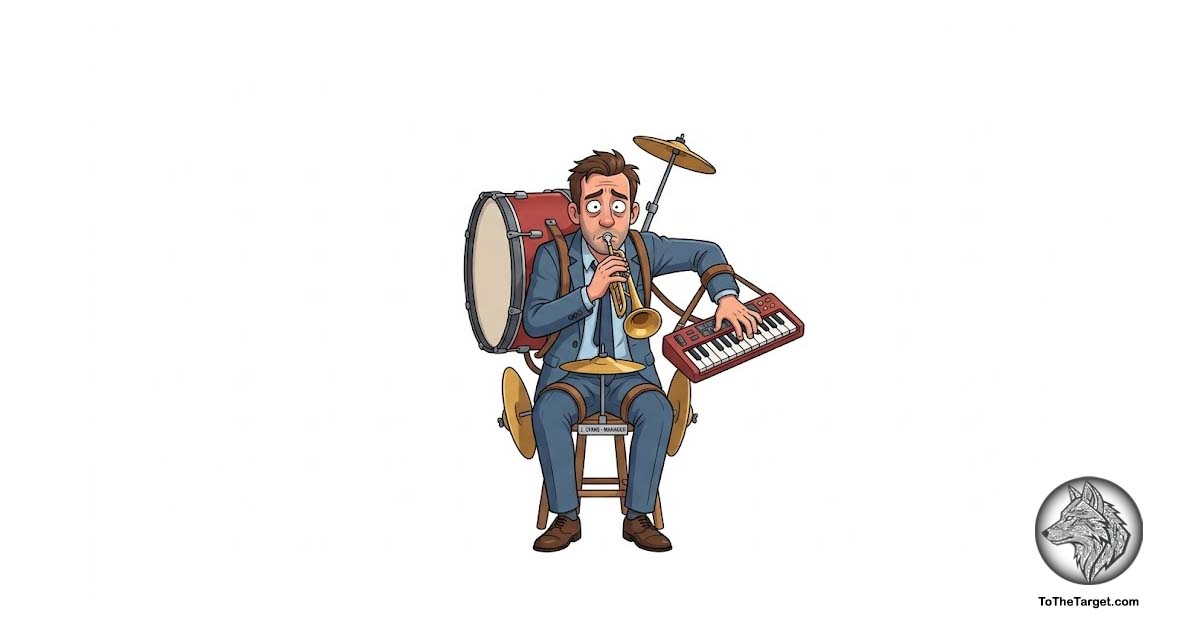
If “Monkeys” are about who does the work, Micro-management is about where the decision is made. Many managers pride themselves on “knowing everything that moves in the company.” In reality, this is a life sentence at the workplace. If you are involved in approving every 5% discount for a minor client or choosing the color for a protocol poster, you are not a manager—you are a “details dispatcher,” and you will work from morning until night.
Situation Analysis:
- The Invisible Customs Office: You have created a system where no gear turns without your “OK.” Your people no longer decide; they only “ask.” This transforms them into robots waiting for instructions, and you into the single battery powering the entire factory.
- The “Single Battery” Effect: Your people no longer take initiative because they know you will change something at the end anyway. The system stops instantly when you are in a meeting or on vacation.
- The Opportunity Cost: While you are checking a 50-euro email, you lose sight of a 50,000-euro opportunity or a 100,000-euro risk.
The Golden Rule: Management by Exception The system must run by itself in 90% of cases. You should be alerted only when something deviates from the established path (the exception). If everything is on track, your presence is not necessary; it is actually harmful because you slow down the process.
How to apply this immediately: Establishing Decision Thresholds Stop demanding to be asked every single time. Establish clear “flight corridors”:
- The Financial Threshold: “Any expense or discount under 500 euros is decided at your level. Do not ask me; just inform me at the end of the week through a one-page report.”
- The Impact Threshold: “If the error affects a strategic client, call me immediately. If it’s a small, recurring client, solve it yourself and tell me on Monday how you proceeded.”
The Efficiency Math: If you intervene in 10 small decisions a day (emails, discounts, colors), each consuming just 5 minutes of concentration, you lose 50 minutes directly. But beware: studies show you need 23 minutes to refocus on strategic work after each interruption. Practically, your workday is fragmented into pieces so small that your brain never gets around to solving the 50,000-euro problems.
If you liked this article, you’ll love what’s inside. This tool is forged and battle-tested inside our playbooks: