What is RACI, exactly?
RACI is a responsibility assignment matrix—a simple table that maps Activities (what needs to be done) against People (who does it). Within an organization, it serves as the “fundamental law” of execution.
The Roles Defined
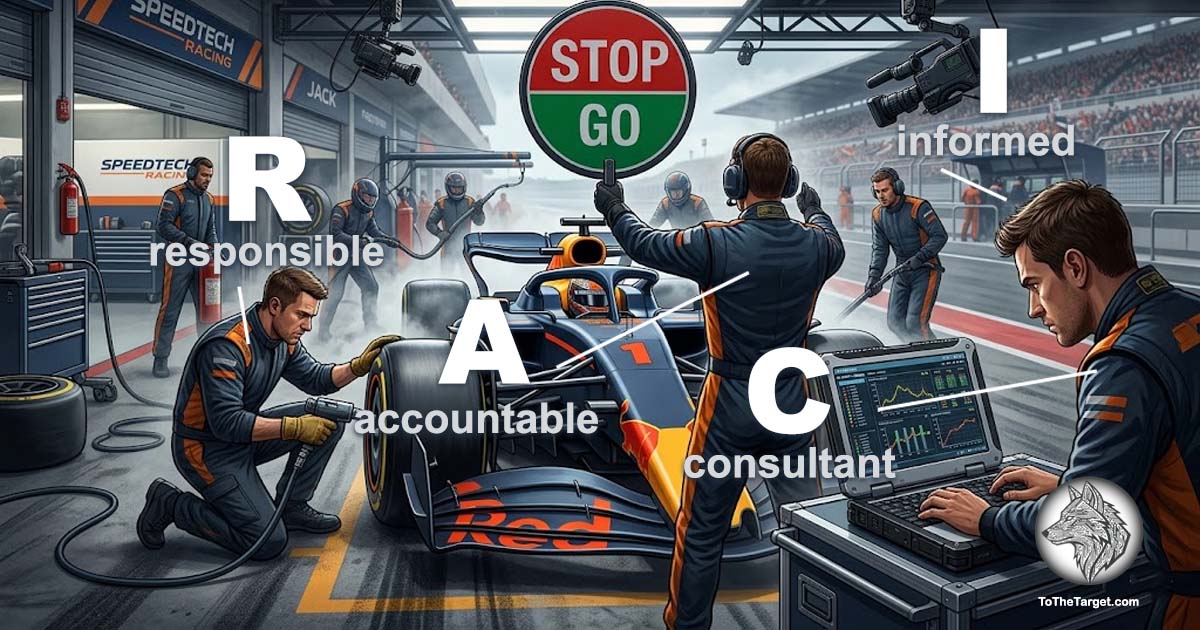
- R – Responsible (The Doer): The person performing the task. They are the experts bound by their job description and the Definition of Done. They answer to the manager for the quality of execution.
- A – Accountable (The Owner): The most critical role. The Accountable person is the only one who answers for the outcome to higher echelons (Board, shareholders, or authorities). A manager can delegate the work (Responsibility), but can never delegate the Accountability. If the task fails, the one with the “A” is the one whose mandate is on the line.
- C – Consulted (The Expert): Specialists who provide support. A Consultant has authority only within the boundaries of their competence (e.g., Legal does not set the price, but defines the contractual clauses). We classify them into two categories:
- Support Consultant (C-Soft): The person you ask for their experience or technical perspective. The Accountable (A) person may choose to ignore this advice if they are willing to accept the risk.
- Compliance Consultant / Gatekeeper (C-Hard): The one from whom you are obligated to obtain a “visa.” Without their approval (Legal, Quality, Audit), the process stops. Often, this consultant is external (ISO bodies, regulators like the Central Bank). If you ignore a C-Hard, the manager’s “protective shield” vanishes instantly.
- I – Informed (The Spectator): Those who need to know what is happening to adjust their own workflows but have no vote or veto power. There are four categories:
- Dependents (Downstream): Those whose work begins only after your task is finished (e.g., Logistics).
- Supervisors (Monitoring): Risk or control departments that collect data (e.g., automated reporting to Central Banks).
- Authorities (External Compliance): State bodies notified by law.
- The Public (Communication): The press or customers (e.g., during price changes).
Note: The key to this system is the clear separation between Responsibility (those who “break a sweat”) and Accountability (the one who “takes the heat”).
The 3 Critical Utilities
- Eliminating Ambiguity: The biggest enemy of execution is the phrase: “I thought my colleague was doing it.” RACI forces the system to state: “No, YOU are Responsible; they are only Informed.”
- Balancing Workload: You can immediately see if an employee is overloaded with “Rs” or if a manager is a bottleneck with too many “As.”
- Speed of Decision: You know exactly who to go to for a signature. You don’t ask five people; you go straight to the “A” in the table.
Accountability as a Protective Shield
A common mistake is believing that if the manager is Accountable, the subordinate has no responsibility. False. The worker’s responsibility is tied to their employment contract. However, the Manager (the one with the “A”) acts as a shield for the team. When an Accountable manager follows the advice of a Certified Consultant to the letter, they create a legal shield. They haven’t just “hoped for the best”; they have engineered the safety of the process. If the system fails despite these measures, the manager can demonstrate maximum diligence, shifting the burden to the expert who certified the work.
The Enron Lesson: The Illusion of Outsourcing Risk
Accountability cannot be outsourced. You can buy an audit, but you cannot buy “innocence” if your system is fundamentally flawed. The role of the Accountable leader is to ensure that the control “sensors” are real, not just checkboxes on a piece of paper.
The Secret of Execution: Cascading Accountability
Performance occurs when every link in the chain is Accountable for the level below and Responsible for the level above. The secret to sleeping soundly at night is not micromanagement, but ensuring that procedures are robust enough so that if an individual makes an execution error, the system—and your mandate—remains intact.
Two “Golden Rules”:
- The “Single A” Rule: In Project Management, the biggest risk is “co-leadership.” If you put two people with an “A” on a task, it will take twice as long and cost twice as much. Only one A per row.
- The “Simple Diagram” Rule: Too many “Cs” means bureaucracy. Too many “Is” means noise. You want many “Rs” (doing the work) and as few “opinions” (C) as possible.
Why I Recommend RACI for Delegation
Delegation without RACI is merely a request. To delegate correctly, you must complete:
- The Task: What exactly are you delegating?
- R (Responsible): Who is doing the work?
- A (Accountable): You, the manager, remain the A. You hand over the work, but not the ultimate accountability.
- C (Consulted): Who holds the expertise? Who must provide a mandatory “visa”?
- I (Informed): Who is affected? Who needs to know it’s done?
If you liked this article, you’ll love what’s inside. This tool is forged and battle-tested inside our playbooks: