The biggest mistake an overwhelmed manager makes is “desperation delegation”: handing a task to the first person they see or whoever seems less busy. The result is almost always poor work, a missed deadline, or a nervous breakdown.
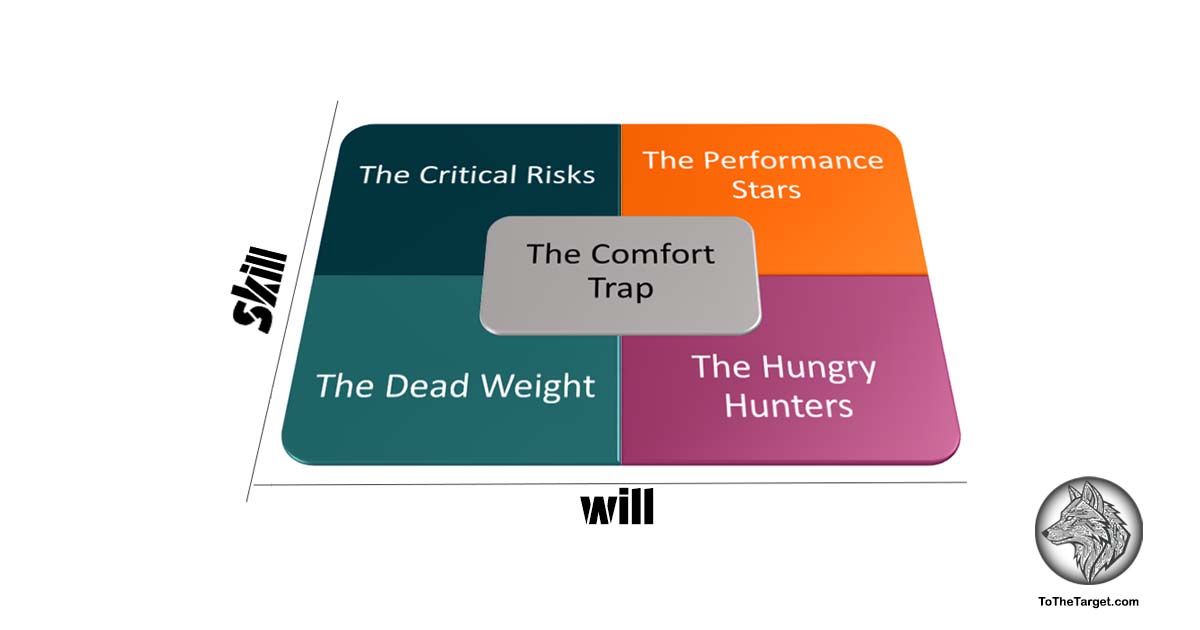
Delegation is not a game of chance; it is a smart investment of resources. To invest correctly, you must use the Skill vs. Will Matrix, which divides the team into four categories, each requiring a different management strategy.
1. High Skill / High Will (The Star)
This is the person who “can and wants to.”
- Strategy: Full Autonomy.
- Fatal Mistake: Micromanaging them. If you tell them how to drive every nail, you will demotivate them. Provide the DoD (Definition of Done) for the final result and let them find their own way.
- Warning: Do not “bury” them in tasks just because they are the only ones who deliver; you risk burning them out.
2. Low Skill / High Will (The Enthusiastic Junior)
This is the person who “doesn’t know yet, but is ready to move mountains.”
- Strategy: Training and Guidance.
- The Investment: You must allocate time for training. Do not throw critical tasks at them without a safety net (Checkpoints). This quadrant offers the highest long-term ROI (Return on Investment).
3. High Skill / Low Will (The Bored Expert)
This is the person who “knows, but isn’t in the mood.”
- Strategy: Motivation or Challenge.
- Diagnosis: Usually, these people have plateaued. They need a new stake, recognition, or a change of context. If you don’t “wake them up,” they will become a toxic drag on the rest of the team with their jaded attitude.
4. Low Skill / Low Will (The Passenger)
The person who “neither knows nor wants to.”
- Strategy: Release (Exit).
- The Brutal Truth: “Merciful” managers waste months trying to resuscitate these employees. It is a useless drain of energy. Your time is too expensive to spend trying to teach someone who doesn’t want to learn.
In other management books, you will find a different approach. Classic theory suggests that you should try to motivate the Bored Expert and closely supervise the Passenger. Well, I’m telling you that the best solution is to let them go.
The Efficiency Calculation: Why Not “Repair” Passengers?
If you spend 5 hours a week trying to correct the work of a Low Skill/Low Will employee, you lose over 250 hours a year. At an average management cost, this means thousands of euros thrown out the window to maintain mediocrity.
If you invest those same 5 hours in an Enthusiastic Junior, within 3 months you will have someone who produces autonomously, freeing up 20 hours of your time per month.
Managing the Demotivated Expert
As a manager, you cannot afford to have people in this situation. First, because they are wasted resources—you pay them at a senior level, but they produce mediocre work. Second, they destabilize the entire team and challenge your authority.
Before taking drastic action, perform an “Enthusiasm Audit” based on the three major causes of demotivation:
- Proximity Pollution: Check if the expert is influenced by another toxic colleague. Boredom and cynicism are contagious.
- Plateauing through Routine: A brain trained for complex tasks enters “survival mode” if it does the same thing for 5 years.
- Perceived Injustice: If the employee has witnessed “nepotism” or if their effort wasn’t recognized, they enter a “silent strike”—producing the bare minimum while using their remaining energy for sarcasm.
Sometimes, perceptions are wrong due to a communication failure. The expert may suffer from “Context Illiteracy”—they don’t understand the economic reasoning or the final impact on the client’s life. A good manager doesn’t just delegate tasks; they delegate Meaning.
The Extraction Strategy
If, after attempting rehabilitation, the person remains toxic, they must be removed. However, to avoid paralyzing the company, do not act impulsively. Follow the Extraction Procedure:
- Expertise Transfer: Before announcing the departure, delegate the critical task of documenting all processes they manage.
- Shadowing: Have them train an “Enthusiastic Junior” under the pretext of freeing up their time for “more complex” tasks.
- Execution: Once their expertise is duplicated in the system or other people, you can end the collaboration without the firm collapsing.
A middle quadrant—Medium Skill / Medium Will—should be added to the original matrix. While it offers stability, Jack Welch’s vision teaches us that this state must be temporary. In fact, the gray zone is the most dangerous trap: it’s not bad enough to force you into action (firing them), but not good enough to help you grow. It is a “slow death.”
Conclusions
- Delegation starts with a mirror. Look at the person in front of you: are they a hungry hunter who just needs a map, or a passenger waiting for you to carry their backpack?
- As a manager, your duty is to act as a centrifugal force: push them toward the edges. Raise their skills through training or resuscitate their Will through new challenges. Do not allow the gray zone to become a final destination.
If you liked this article, you’ll love what’s inside. This tool is forged and battle-tested inside our playbooks: