The Meeting Guillotine: The Engineering Architecture That Restores Your Calendar’s Sovereignty
How to Eliminate 70% of Sterile Meetings, Destroy Teams Bloat, and Transform Corporate Gatherings into a Surgical Decision Engine
The greatest fraud in modern enterprise does not occur at night through cyberattacks or sensational embezzlement.
It takes place in broad daylight, under fluorescent office lights, at 10:00 AM, via a routine calendar notification:
“Invite: Project Sync (Duration: 60 minutes. Attendees: 14 directors and specialists).”
If an employee walked into the corporate cashier’s office and removed 600 USD in cash from the drawer, building security would intervene, an internal investigation would launch, and the individual would be terminated on the spot. Yet when an employee dispatches an agenda-less meeting invite to ten senior directors and engineers—burning precisely that same 600 USD in payroll capital alongside thousands of dollars in lost opportunity costs—everyone smiles, nods politely, and murmurs: “Thanks for the alignment!”.
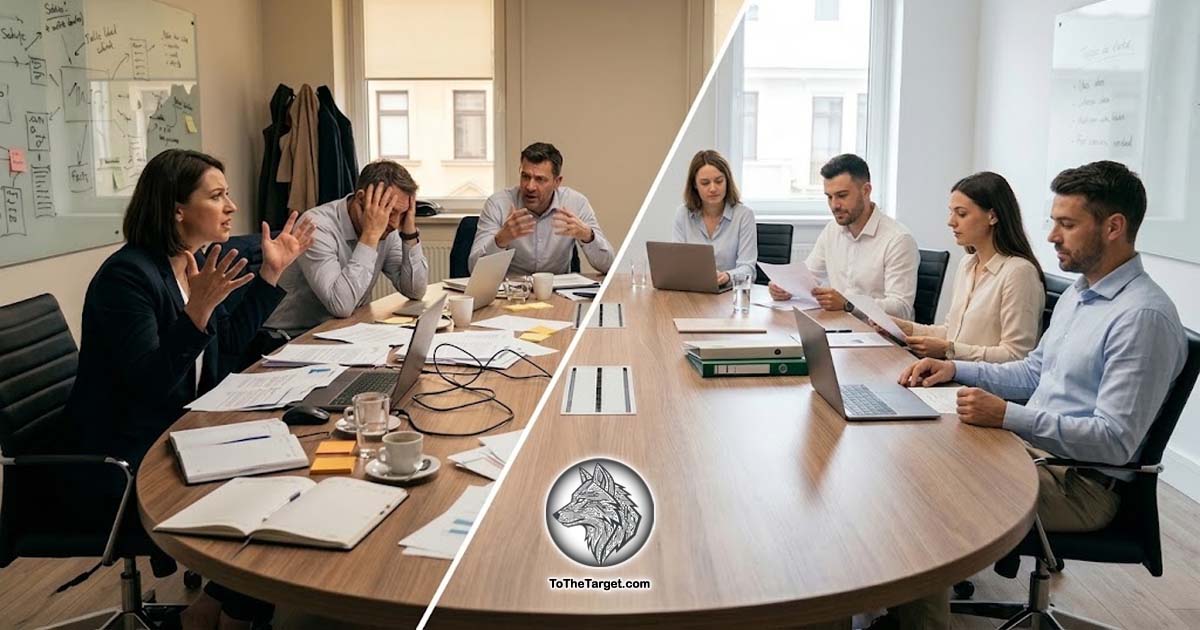
Every executive knows the corporate torture: calls on Teams where three-quarters of the room sits on mute with cameras off, 50-slide monologues read aloud, egos exploding at the slightest challenge, and sessions that adjourn exactly as they opened: with zero decisions made and another meeting scheduled for next week.
You do not have a time problem. You have an organization suffocating beneath bureaucratic obesity.
Corporate Obesity and the Empty Calories of Management
In medicine, the most insidious pathology is morbid obesity: the patient does not collapse overnight; they consume empty, nutrient-free calories day after day. The heart expends double the effort for every beat, blood vessels gradually clog, and physical mobility vanishes.
In modern management, sterile meetings are the empty calories of the corporation.
Every agenda-less meeting, every Teams call with 15 attendees hiding behind black screens, every 50-slide monologue read aloud, and every committee convened solely to dilute accountability represents a spoonful of bureaucratic fat poured directly into your firm’s operational arteries. The enterprise becomes sluggish, exhausted, incapable of rapid maneuver, and paralyzed before agile competitors who execute while you are still “aligning.”
We do not deploy The Meeting Guillotine to punish human beings; we deploy it to sever—rapidly and without hesitation—the dead weight that suffocates the organization.
Front I: Universal Governance and Cutting the Amorphous Soup
Before learning how to lead a meeting, an executive must master what to eliminate upfront. The foundational pillar of the system is the Taxonomy of the 3 Functional Types:
- Strategic Alignment Meetings (Top-Down Flow): The leader speaks 80% of the time, outlining strategic vision and flight corridors, while attendees ask brief clarifying questions.
- Intelligence-Gathering Meetings (Bottom-Up Flow): The leader remains silent 90% of the time, extracting raw ground truth from the frontline and auditing operational friction.
- Problem-Solving Meetings (Cross-Functional Flow): A tight core of domain specialists convenes to resolve an acute operational crisis or allocate capital.
The most expensive failure of an untrained manager is blending these three formats into a single amorphous two-hour soup. When leadership attempts to deliver administrative announcements, harvest feedback, resolve a manufacturing dispute, and debate next year’s strategy inside the same hour, working memory short-circuits. The outcome is systemic paralysis.
Two non-negotiable operational hygiene rules govern this taxonomy:
- Jeff Bezos’s Two-Pizza Rule and the Ringelmann Effect: If a decision team cannot be fed by two large pizzas (strictly 5 to 8 people), the room is bloated. Past this threshold, communication channels explode mathematically according to the formula N(N-1)/2, and individual responsibility collapses into passive social loafing.
- The Agenda Police and Meeting Definition of Done (DoD): An invitation lacking an agenda framed as operational questions and devoid of a measurable deliverable upon adjournment represents an abuse of company capital. In elite organizations, every employee holds the executive right to reject such meetings via the No Agenda, No Attenda protocol.
Front II: Presentation Velocity and Alignment Without Illusions
When an executive or specialist must communicate a strategic directive or project roadmap, conventional 45-minute presentations represent intellectual laziness. Speaking at length is easy because an individual can wander without structure; compressing a complex initiative into under 7 minutes demands hard intellectual synthesis.
The mechanical guillotine of time enforces automated constraints that cannot be bypassed:
- PechaKucha 20×20: Exactly 20 slides advancing automatically every 20 seconds, capping spoken delivery at strictly 6 minutes and 40 seconds. No clicker, no conversational tangents.
- The 10-Minute Daily Stand-Up: The entire execution team on their feet first thing in the morning. The physical discomfort of standing naturally eliminates rambling, isolating strictly the operational blockers of the day.
- The Kick-Off Protocol: Major initiatives launched exclusively via email collapse at first contact with reality because passive text invites self-serving misinterpretations. A 30-minute synchronous Kick-Off breaks digital avatar anonymity (The Milgram Effect), establishes direct human rapport, and deploys the Teach-Back technique: leadership never asks “Did everyone understand?”, but requires operational leads to articulate in their own words what workflows they halt and what they initiate Monday morning.
Front III: Harvesting Ground Truth and Decisional Convergence
When an organization must resolve complex dilemmas or innovate, conventional committees fail because personal egos collide head-on:
- AI-Augmented Hybrid Brainstorming: The parlor game of walls covered in colorful sticky notes generates sterile fantasies. The modern framework deploys artificial intelligence for raw option generation at an operator’s desk (via the 4 pillars: Role, Ground Mud, Negative Constraints, Output Structure), while the live meeting utilizes the human team as a 360-degree camera system that filters strictly feasible solutions for real-world clients.
- Internal Focus Groups: Formal executive reporting decks are frequently “watermelon reports” (green on the outside, deep red with unresolved crises on the inside). To capture ground truth, leadership convenes frontline operators while strictly barring direct supervisors from the room, enforcing the “Your friction, your solution” rule, and closing the trust loop within 72 hours.
- Parallel Thinking (Edward de Bono’s 6 Thinking Hats): Instead of optimists warring against cynics in “spaghetti thinking,” the entire room adopts the identical cognitive mode simultaneously. When auditing risks, everyone examines vulnerabilities; when evaluating upside, everyone hunts for value. Hidden agendas are dismantled by demanding cold empirical data under the White Hat.
- The 6-Page Narrative Memo and Silent Meetings: Jeff Bezos banned PowerPoint at Amazon because slides conceal flawed logic beneath personal charisma and animations. At Amazon, the opening 20 minutes of a session occur in cathedral silence: every executive reads a dense narrative memo (PR/FAQ) and records margin notes. Deliberation opens directly with diagnostic questioning.
Front IV: Execution, Nominal Accountability, and the Digital Purge
A meeting concluding with the vague phrase “we agreed to handle this” guarantees that one week later nothing will be delivered. Collective responsibility is, in operational reality, zero responsibility.
The system seals this leakage through three structural mechanisms:
- The DRI Criterion (Directly Responsible Individual – The Apple Model): Zero decisions exit the room without a single nominal owner assigned in writing. One accountable individual holds the wheel and answers for the deliverable.
- The After Action Review (AAR – Military Doctrine): To ensure a firm does not possess 50 years of experience repeated poorly 50 times, every operational phase concludes with a 15-minute debrief governed by the 25% facts – 25% root causes – 50% future formula. Lessons learned are codified into living, one-page checklists.
- The Great Digital Purge: On Microsoft Teams and Zoom, the absence of friction has degraded communication into a continuous operational distraction. The countermeasure is the Single-Pizza Rule (maximum 4 to 5 people on screen), mandatory cameras on, automated 20- and 45-minute calendar caps for biological recovery buffers, and replacing routine status updates with 3-minute asynchronous video memos (Loom).
Victor’s Pizza Rule: The Therapy of Public Space
Among all the protocols codified in this operating system, there is one practical deblocking tool to deploy when deliberations deadlock: Victor’s Pizza Rule.
When a critical problem is paralyzed by corporate posturing, halt the mammoth meeting, dismiss spectators back to work, and isolate strictly the 3 or 4 individuals indispensable to the fix. Exit the corporate office and walk over to a quiet neighborhood pizzeria.
Why does this environment outperform any formal teambuilding exercise?
- The Social Governor of Common Decency: In a public dining room surrounded by other patrons, a healthy psychological barrier takes effect. Individuals cannot raise their voices, slam documents on the table, or make aggressive gestures without looking ridiculous and drawing stares.
- Activating Baseline Courtesy: The physical context forces civility: sharing food, passing water glasses, maintaining personal space. These elementary gestures disarm the amygdala and dissolve accumulated hostility.
- The Clarity of a Simple Table: Removed from peripheral screens and boardroom pressure, heart rates return to baseline. Executives cease attacking peers over individual sentences. Teams audit numbers with cold objectivity, acknowledge past missteps, and draft the solution in 40 minutes on the corner of a paper napkin.
Be the leader who knows when to lower the guillotine in the boardroom and when to take the team out for pizza to salvage a critical decision.
Executive Conclusions: The Tuesday Morning Directive
A meeting is not an informal gathering. It is an expensive financial transaction where leadership spends the firm’s payroll capital to purchase an assumed decision. If you exit the room without that deliverable in hand, capital was squandered.
The operational test begins Tuesday morning when opening the calendar:
- Identify the first incoming invitation lacking an agenda and a measurable deliverable. Dispatch the standard polite decline: No Agenda, No Attenda.
- Review meetings you personally scheduled. Ruthlessly prune 50% of the attendee roster, transitioning those removed into an asynchronous summary loop.
- Replace your first 45-minute recurring status meeting with a 3-minute asynchronous video memo posted directly to the project channel.
You will experience slight hesitation. That is a natural reaction before a massive wall of tribal inertia, mirroring the classic parable of the monkeys in the cage: nobody recalls where the dysfunctional habit originated, yet everyone mechanically recites the excuse “Well, that’s just how we do things around here.”
The moment the first 5 hours of uninterrupted deep work return to your calendar, the moment your colleagues think before they speak, and the moment operating margins stop bleeding through the floorboards… you will know you severed the vicious circle.
Stop financing your organization’s corporate obesity. Lower the guillotine, liberate your people, and drive straight to the target!
If you liked this article, you’ll love what’s inside. This tool is forged and battle-tested inside our playbooks: