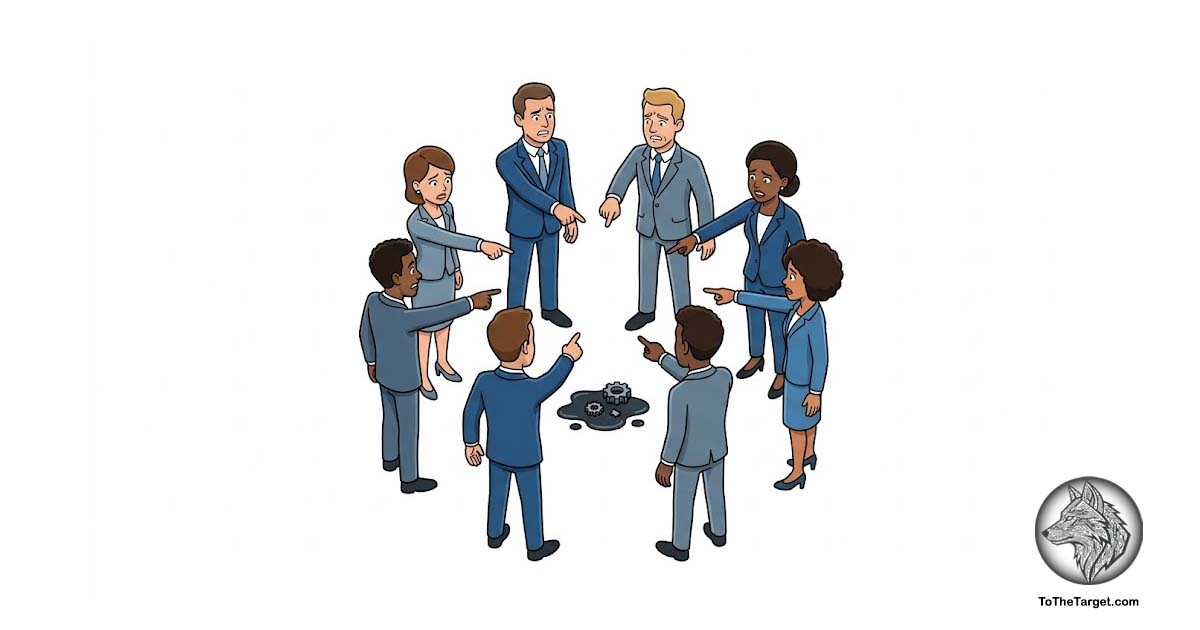
This is the disease of “shared” responsibility. It occurs whenever you delegate a task to a group or to “someone” without putting a single name on the outcome. When responsibility is shared among “us,” it actually belongs to no one.
Situation Analysis:
- Emergency Spectators: When a problem arises, the team looks to you to solve it. They are “doers,” while you are the one “answering” for it. Because you hold the final stake, you are the only one losing sleep over deadlines, while the rest of the team watches from the sidelines, assuming it’s the “boss’s job” to save the day.
- The Dilution of Guilt: In a structure without a clear owner, failure has no father. “I thought my colleague was handling it” becomes the standard excuse, and you are left to pick up the pieces.
The Golden Rule: One Neck in the Noose No matter how large the team is, there must be a single person who is Accountable (the one who answers with their head). Responsibility can be shared, but the person who will be held directly accountable must always be nominated and committed.
The CYA Syndrome (Cover Your Ass): The Excuse Factory
The greatest danger when attempting to eliminate Diffuse Responsibility without building trust is inadvertently creating an Excuse Factory (known in organizational behavior as the CYA Syndrome).
Team members stop focusing on winning the project; instead, they burn 80% of their energy building alibis so they aren’t the ones blamed in the boardroom. Rather than executing the actual task, they send CYA emails (“As discussed, I CC’d you on the risks”), pass the buck, and prepare their legal defense.
When your people’s primary goal shifts from making the project succeed to proving it wasn’t their fault, your operational engine is dead. A team focused on alibis will lose every single time to a team focused on victory.
How to apply this immediately: The “Owner” Method Stop letting tasks float in the air.
- One Single Name: For every project or task, designate an “Owner.” Even if 10 people are working on it, there is only one person whose “health” you will inquire about at the end.
- The Pressure Transfer: Move the stake of the result from your shoulders to the owner’s. They must feel the “heat” of the deadline just as much as you do. If they aren’t feeling any pressure, it means you are working too hard.
The Efficiency Math: In a team of 5 people without a clear “Owner,” the time wasted in meetings asking “who was supposed to do this?” or “I thought you were on it” consumes at least 20% of the team’s capacity. It’s not just your time; it’s everyone’s time. It’s like having a car driving with the handbrake on: you consume a lot of fuel, but you get nowhere.
If everyone is responsible, then no one is.
Stop letting tasks float in the air. When you delegate to a “team” without naming a single owner, you aren’t managing—you’re just hoping for the best. Here is why “Shared Responsibility” is the fastest way to kill your team’s efficiency and how to apply the “One Neck in the Noose” rule.
If you liked this article, you’ll love what’s inside. This tool is forged and battle-tested inside our playbooks: