Deadline Pressure and the Yerkes-Dodson Law: The Execution Catalyst
How to Transform Stress into Pure Velocity, Optimize the Biological Arousal Bell Curve, and Eradicate the Toxic “As Soon As Possible” (ASAP) Trap
If you hand a brilliant professional a complex initiative and instruct them: “Take your time, work on it at your leisure, what matters is that it turns out immaculate,” you have signed that project’s death sentence.
Without a rigid temporal anchor, two destructive dynamics trigger immediately:
- Parkinson’s Law: the task expands automatically, consuming every available minute, manufacturing artificial complexities, and justifying endless postponements;
- The Student Syndrome: even when granted an entire month, the human brain refuses to mobilize heavy metabolic resources until the consequences of inaction become imminent. Real work executes in the final 72 hours regardless, but at the price of four weeks of ambient, background anxiety.
Time devoid of calibrated pressure produces neither excellence nor quality; it manufactures solely lethargy and sterile perfectionism.
In the physics of prioritization, a deadline is not a routine calendar date; it is an energy transformer. It is the gravitational force compressing options, compelling decisive trade-offs, and purging operational agendas of ballast.
Yet pressure is a double-edged sword: insufficient pressure leaves teams asleep at their desks; chaotic or violent pressure triggers organizational fibrillation, cognitive paralysis, and an explosion in operational error rates.
To master this force, modern enterprise governance anchors execution inside a foundational neurobiological principle: The Yerkes-Dodson Law.
The Yerkes-Dodson Law: The Brain’s Performance Bell Curve
Discovered in 1908 by psychologists Robert Yerkes and John Dillingham Dodson at Harvard University, this law defines the empirical relationship between Arousal/Stress and Cognitive Performance.
The relationship takes the exact shape of a Gaussian Bell Curve (Normal Distribution), divided across three distinct operating zones:
Zone 1: Hypo-Activation (The Left Slope — Under-Pressure and Lethargy)
When pressure is minimal or absent (vague horizons, absent accountability), the brain secretes negligible quantities of dopamine and norepinephrine. Symptoms: boredom, apathy, dispersion across administrative trivia, cosmetic perfectionism, and chronic procrastination. Tasks appear monumental precisely because the biological spark required to break starting inertia is missing.
Zone 2: The Apex of the Bell Curve (The Optimal Performance Zone / Flow)
As deadline pressure rises in a calibrated, controlled manner, the brain attains its optimal neurochemical activation threshold. The Mechanism: norepinephrine narrows visual and mental focus, filtering out peripheral noise; dopamine delivers cognitive stamina. Priorities clarify instantly: you distinguish the vital core (Must-Have) at a glance and sever cosmetic details without remorse. Teams deliver in 48 hours what previously stalled across an entire month.
Zone 3: Hyper-Activation (The Right Slope — Over-Pressure and Collapse)
If pressure breaches the critical threshold (unrealistic horizons, firing threats, competing emergencies detonating every 10 minutes), the biological system ruptures. The Mechanism: the amygdala seizes control, flooding the body with excess cortisol and adrenaline. The prefrontal cortex—the biological seat of strategic analysis, cold calculation, and discernment—is effectively taken offline. Symptoms: tunnel vision, disastrous impulsive decisions, fear-driven paralysis, cognitive freezing, and gross errors in basic arithmetic.
The Golden Directive: A leader’s mandate is neither eliminating pressure nor terrorizing personnel. The mission is mechanically stabilizing the enterprise at the apex of the Gaussian bell curve: injecting tension the moment complacency emerges, and decoupling pressure before the team tumbles down the slope of panic.
The Maritime Lesson of the Plimsoll Line: The Physics of Optimal Draft
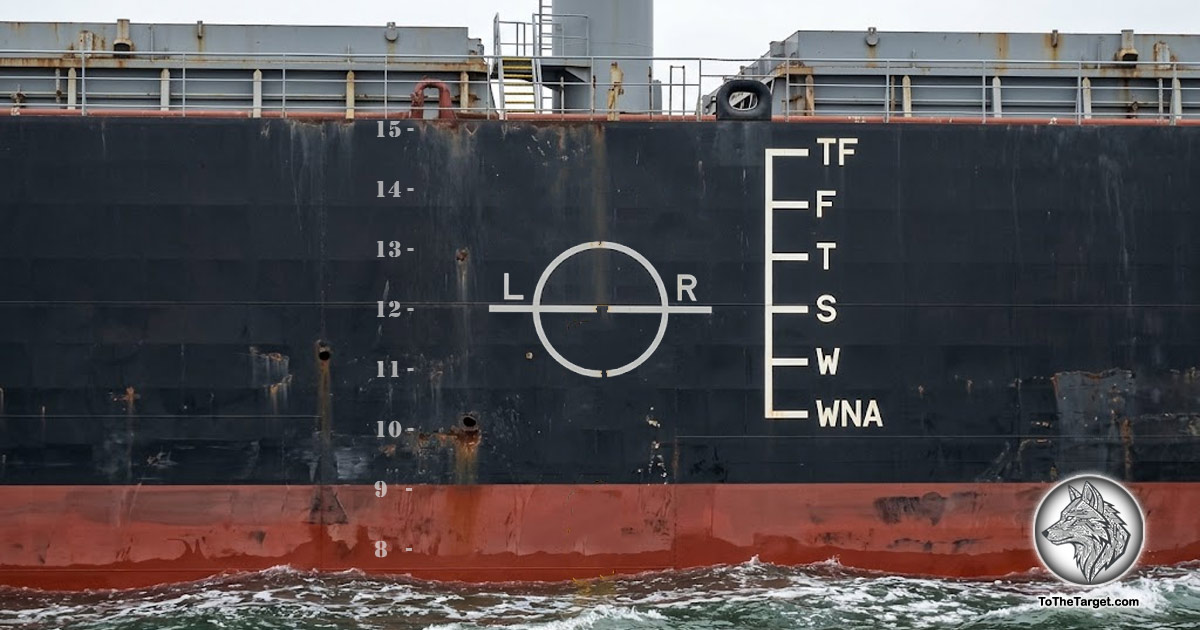
Welded onto the steel hull of every ocean-going vessel sits an unmistakable insignia: a circle bisected by a horizontal line paired with a laddered grid of letters, known internationally as the Plimsoll Mark (The International Load Line), flanked by the vertical numbers of the draft marks measuring hull submersion.
This maritime marking serves as the definitive mechanical embodiment of calibrated pressure:
- If a vessel sails completely unladen (under-pressure), the hull rides dangerously high above the waterline. The stern rises, the propeller emerges partially into the air and thrashes uselessly, thrust efficiency collapses, and the ship enters violent pitching and rolling that threatens structural hull torsion;
- If a vessel is overloaded (over-pressure) past the Plimsoll mark, reserve buoyancy is eradicated, deck hatches are submerged, and the ship founders at the first ocean storm;
- The Optimal Draft: An enterprise operates at peak velocity strictly when laden directly to its designated summer waterline (letter S). The propeller bites the water with maximum torque, the hull cuts steadily through heavy seas, and commercial deadweight capacity is 100% monetized.
In executive prioritization, the Yerkes-Dodson Law is the Plimsoll Line of the human brain: an unpressured team thrashes in the air like an unballasted propeller; a team overloaded past its structural threshold sinks into panic. Elite performance mandates calibrating operational pressure precisely along the optimal waterline.
The Volunteer Firefighter Syndrome and the “Heroic Hangover”
The most toxic pathology of chaotic enterprises is siren addiction:
- In a volunteer firefighting brigade, personnel spend 90% of their shift drinking coffee and playing board games. When the alarm wails, they jump into engines and plunge into a violent 48-hour hyper-activated battle against flames until total physical exhaustion;
- In corporate environments, the identical pattern manifests: management postpones hard decisions throughout the week, initiatives languish in Zone 1 (lethargy), and 48 hours before delivery, general alarms detonate.
The team is forced into Zone 3: pulling all-nighters, consuming liters of coffee and energy drinks, patching a deliverable together on the fly, leaving at dawn with an ephemeral rush of triumph: “We were heroes, we saved the day once again!”.
Yet this heroism conceals a devastating psychological trap: The Heroic Hangover.
The rush of glory lasts merely hours, fueled artificially by overnight dopamine:
- The Recognition Rupture (Perceived Injustice): By midday, when executive leadership receives the deliverable as a routine baseline (“Good, but it was your duty to deliver on time”) and moves on coldly, morale collapses. Unacknowledged personal sacrifice converts instantly into a toxic sense of injustice and futility;
- The Biological Memory of Stress (The Negativity Bias): Under evolutionary negativity bias, the human brain prioritizes retaining pain and trauma. Personnel quickly forget hollow applause, but the physical organism remembers insomnia, gastritis, heart palpitations, and muscular tension. The body builds defensive scar tissue: nobody becomes more loyal following repeated all-nighters. Instead, employees grow cynical, erect defensive CYA armor, and subconsciously sabotage future initiatives to prevent repeating the trauma.
Last-minute heroism is not proof of dedication; it is the invoice of incompetent planning.
The “ASAP” Plague: Why “As Soon As Possible” Destroys Prioritization
The single most toxic acronym in business communication is ASAP (As Soon As Possible).
Delegating an item marked “ASAP” constitutes systemic operational sabotage:
- ASAP is a temporal non-value: There is no day of the week named “as soon as possible” and no hour named “quickly.” To the executor, ASAP signifies either “Abandon everything and panic right now” or “There is no fixed deadline, so I will address it whenever I feel like it”;
- ASAP fractures existing prioritization: If an analytical specialist executes focused Deep Work on the Big Task of the day (The 1-3-5 Rule) and receives an incoming request tagged ASAP, their priority architecture is shattered by an arbitrary, subjective urgency;
- ASAP is disguised managerial cowardice: It signals an executive who refuses the intellectual labor of establishing an objective sequence of priorities and offloads their anxiety onto subordinates.
The ToTheTarget Iron Rule:
The acronym “ASAP” is formally prohibited across operational communication. Every delegated task receives a deadline built from three concrete anchors: Day, Hour, and Definition of Done (DoD) (e.g., “Thursday, by 2:00 PM, formatted matching Specification X”).
Pressure Engineering: Constructing Healthy Deadlines
To maintain an enterprise at the apex of the Yerkes-Dodson bell curve without biological depletion, deploy three engineering calibration levers:
- Internal Hard-Stops (The Calibration Buffer)
If the final contractual milestone with an external client is November 30, communicating November 30 to your internal team is novice malpractice! Establish an unbending internal hard-stop on November 20. The internal deadline is enforced with contractual rigor (including full acceptance simulations and audits). The remaining 10 days serve as your calibration buffer. Unforeseen anomalies or technical bugs are resolved without panic, in standard working rhythm, without the external partner detecting a single millimeter of slippage. - The Rhythmic Cadence of Weekly Checkpoints
A distant milestone placed 6 months in the future is biologically inert: the human brain ignores it for 5 months, only to collapse in panic during the final week. Apply the canonical distinction between Milestones and Checkpoints: - A 6-month Milestone is merely an autopsy at the morgue if you are late;
- A Checkpoint every 7 to 10 business days is an in-stride operational pulse check;
Every checkpoint mandates a demonstrable, functional deliverable. The team remains continuously within the optimal arousal zone at the top of the bell curve, distributing workload evenly without midnight terror spikes. - The Two-Speed Clock (Synchronizing Endurance Rhythm)
An elite enterprise functions across two complementary velocities: - The Sprint Clock (Tactical Velocity — Days and Weeks): Governed by tight deadlines, rigid timeboxing, and the 1-3-5 Rule. Execution is alert, dynamic, oriented toward closing the active deliverable;
- The Strategic Clock (Cruising Velocity — Quarters and Years): Governed by patience, deliberate incubation of complex dilemmas, and capital allocation. Decisions regarding mergers, acquisitions, core technical architecture, or enterprise restructuring are never executed under the pressure of a 24-hour clock.
Executive Conclusions
- The Chaotic Adrenaline Firefighter: Sets no firm deadlines, communicates via “ASAP,” oscillates between weeks of lethargy and midnight terror, destroys team health through the heroic hangover, and ships compromised deliverables at the eleventh hour.
- The Master of Tempo (Commander of the Performance Bell Curve): Understands the neurobiology of pressure. Anchors execution on internal hard-stops preceding contractual dates, decomposes macro-horizons into rhythmic weekly checkpoints, permanently eliminates toxic ASAP communication, and sustains the organization at the apex of optimal performance through a predictable, disciplined tempo.
Time pressure does not need to be an incinerating blaze. Make the deadline your most lethal ally: calibrate the tension, draw the line in the sand, and convert every passing second into a lever of sovereign execution!
If you liked this article, you’ll love what’s inside. This tool is forged and battle-tested inside our playbooks: