The Two-Pizza Rule and the Ringelmann Effect: The Mathematics of Optimal Meeting Size
How to Eliminate Social Loafing, Communication Channel Explosions, and the Fear of Meeting Exclusion
In most modern organizations, meeting attendee lists are artificially inflated not out of an authentic operational need, but out of a deeply flawed approach to human psychology and Maslow’s Hierarchy of Needs.
When an employee discovers they were excluded from a project meeting, two primal survival alarms trigger in their prefrontal cortex:
- The Fear of Tribal Ostracization (The Need for Belonging): In ancestral evolutionary psychology, being excluded from the decision-making circle signaled abandonment by the tribe.
- The Threat to Status and Relevance (The Need for Esteem): The individual experiences a direct blow to their professional vanity: “If I am not in the room, my opinion does not matter, I am not respected, or I am deemed unimportant to the company’s future plans.”
To avoid interpersonal friction and appease executive egos, untrained managers default to the easiest path: they invite everyone.
The outcome? A meeting convened for a straightforward technical decision degrades into an amorphous, bureaucratic conclave with 14 people in the room or on a Teams link. Three individuals dominate the conversation, two argue aggressively, while the remaining nine sit on mute, stare out the window, or scan their inboxes.
The manager secured a temporary illusion of harmony, but completely destroyed operational velocity by activating two unyielding laws of mathematics and social psychology.
Metcalfe’s Mathematics: Communication Channel Explosions
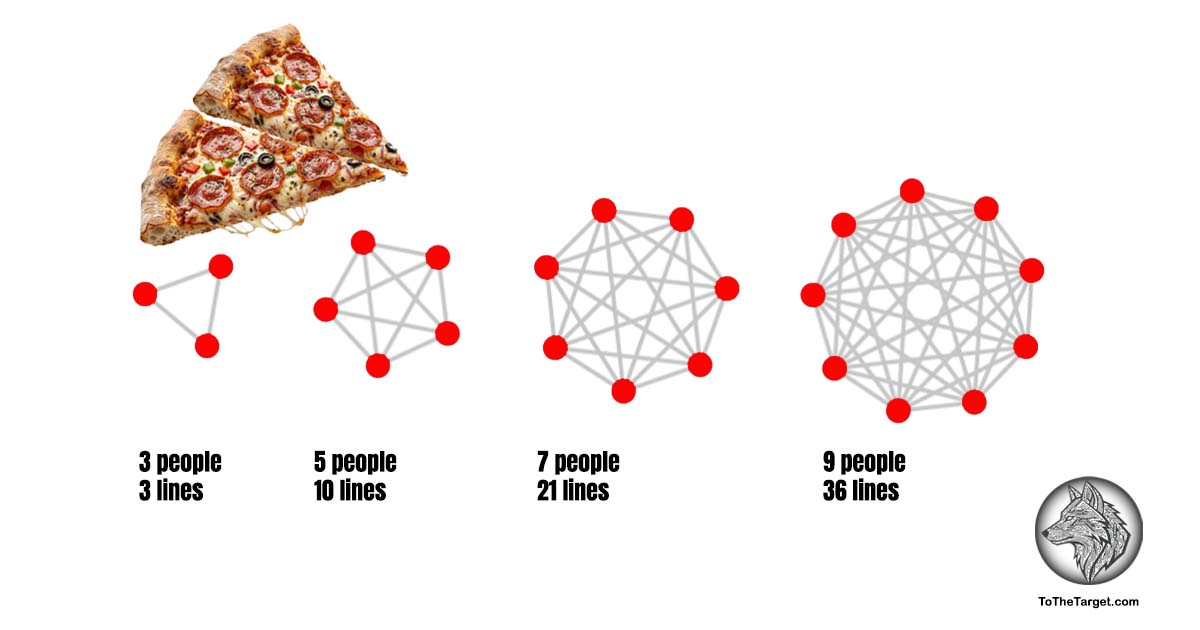
Whether phrased as the American “Two-Pizza Rule” or an informal pastry tray in a European boardroom, Jeff Bezos’s empirical insight at Amazon mapped directly to Metcalfe’s Law of Network Density.
Meeting complexity does not grow linearly with each added participant; it escalates exponentially, governed by the formula of unique communication channels:
Communication Channels = N x (N – 1) / 2
where N represents the total number of individuals in the room:
- Group of 4 participants: 4 x 3 / 2 = 6 communication channels. Direct, fast, and dense.
- Group of 6 participants: 6 x 5 / 2 = 15 communication channels. Optimal for debate and critical analysis.
- Group of 8 participants (The Two-Pizza Ceiling): 8 x 7 / 2 = 28 communication channels. The biological limit for operational decision-making.
- Group of 14 participants (The Amorphous Committee): 14 x 13 / 2 = 91 communication channels!
At 91 parallel channels, cognitive bandwidth is suffocated by coordination noise: interruptions, verbal corrections, clarifications, and side conversations. Over 70% of meeting time is consumed managing human traffic rather than solving the operational problem.
The Ringelmann Effect: The Rope-Pulling Experiment and Social Loafing
The second destructive force was uncovered in 1913 by French agricultural engineer Max Ringelmann:
Ringelmann measured the physical force exerted by volunteers pulling a rope, comparing individual output against groups of varying sizes:
- A single individual: Pulls at 100% of maximum muscular capacity.
- Group of 2 individuals: Each person pulls at 93% of individual capability.
- Group of 3 individuals: Output drops to 85%.
- Group of 8 individuals: Output collapses to just 49% of real capacity!
This organizational pathology is termed Social Loafing: as a group expands in size, the individual sense of accountability and cognitive effort declines proportionally.
When an executive stands alone before a critical problem, their brain operates at 100% capacity. When that same executive sits in a boardroom surrounded by 12 peers, the brain reflexively shifts into cognitive conservation mode: “There are plenty of smart people here; someone else will speak up.”
Diffusion of Responsibility: The Corporate Bystander Effect
Social loafing breeds the greatest enemy of operational execution: The Bystander Effect in Business Decisions.
When a decision is forged inside a committee of 14 people:
- Nobody possesses individual ownership of the outcome.
- If the project derails three months later, every participant has an excuse: “We all agreed in the meeting, it was a collective decision, it wasn’t just my fault!”.
- Large committees serve as an unconscious psychological flak jacket for weak leadership: they dilute blame collectively to prevent nominal accountability.
Pruning the Attendee List: The Protocol of Tactful Communication
To restrict decision meetings strictly to 5 to 8 people without triggering tribal panic or political resentment, execute a three-step protocol:
- The Two-Tier Architecture (Active Core vs. Asynchronous Circle):
- The Active Decision Core: Strictly 5 to 8 individuals possessing essential baseline telemetry, the operators directly executing the fix, and the single accountable leader (Single Point of Accountability).
- The Asynchronous Information Circle: Colleagues previously invited out of courtesy receive a 3-sentence summary or a 2-minute audio/video memo (Loom) post-meeting: What was decided, who owns it, and the hard deadline.
- The Tactful Reframing Script (Protecting Executive Ego):
Human beings instinctively interpret silence as rejection (“They are pushing me out”). The leader communicates with explicit transparency: “Mark, I did not include you in Tuesday’s meeting not because your perspective is undervalued, but for the exact opposite reason: I have immense respect for your focus time. I am protecting you from two hours of operational noise so you can finalize Project X. I will send you the decision summary at 11:30 AM, and my door is open for strategic objections.”
- The Mandatory Engagement Rule (Zero Tourists):
If an individual is invited to an active 6-person session, passive observation is prohibited. If a participant contributes zero data, analysis, or critical questions over a 15-minute window, they are released from the meeting.
Executive Conclusions
- The Insecure Manager: Packs the room with 15 people to appease corporate vanity, triggers social loafing, diffuses accountability, and burns thousands of dollars on passive spectators.
- The Two-Pizza Leader: Understands Metcalfe’s mathematics and Maslow’s tribal psychology, communicates with tact to safeguard team morale, caps decision meetings at 5 to 8 active operators, and transforms non-invitation into a high-status gift of focus time.
If two pizzas cannot feed the room, the meeting is too large. Prune the list, protect egos with tact, and drive the decision!
If you liked this article, you’ll love what’s inside. This tool is forged and battle-tested inside our playbooks: